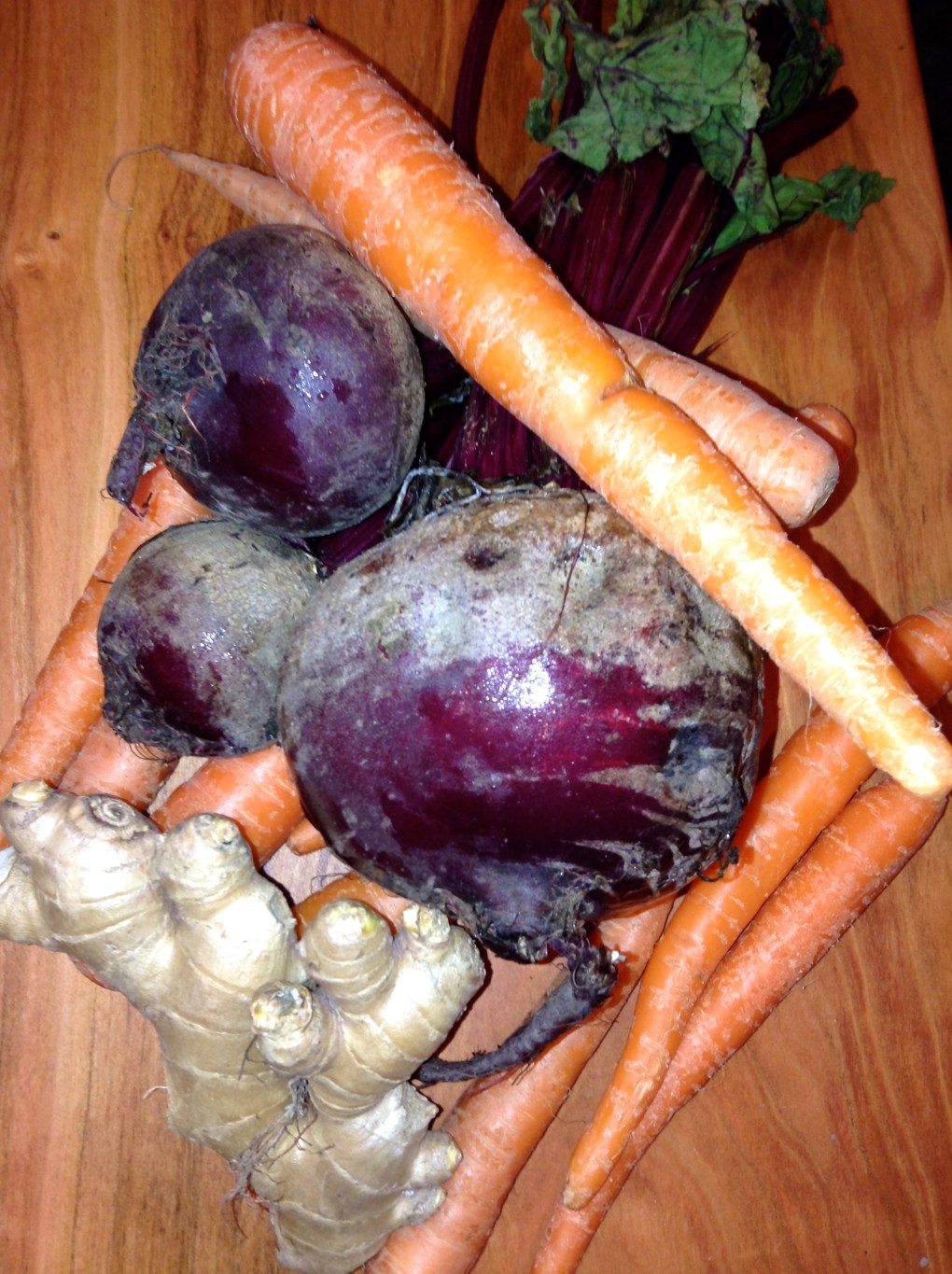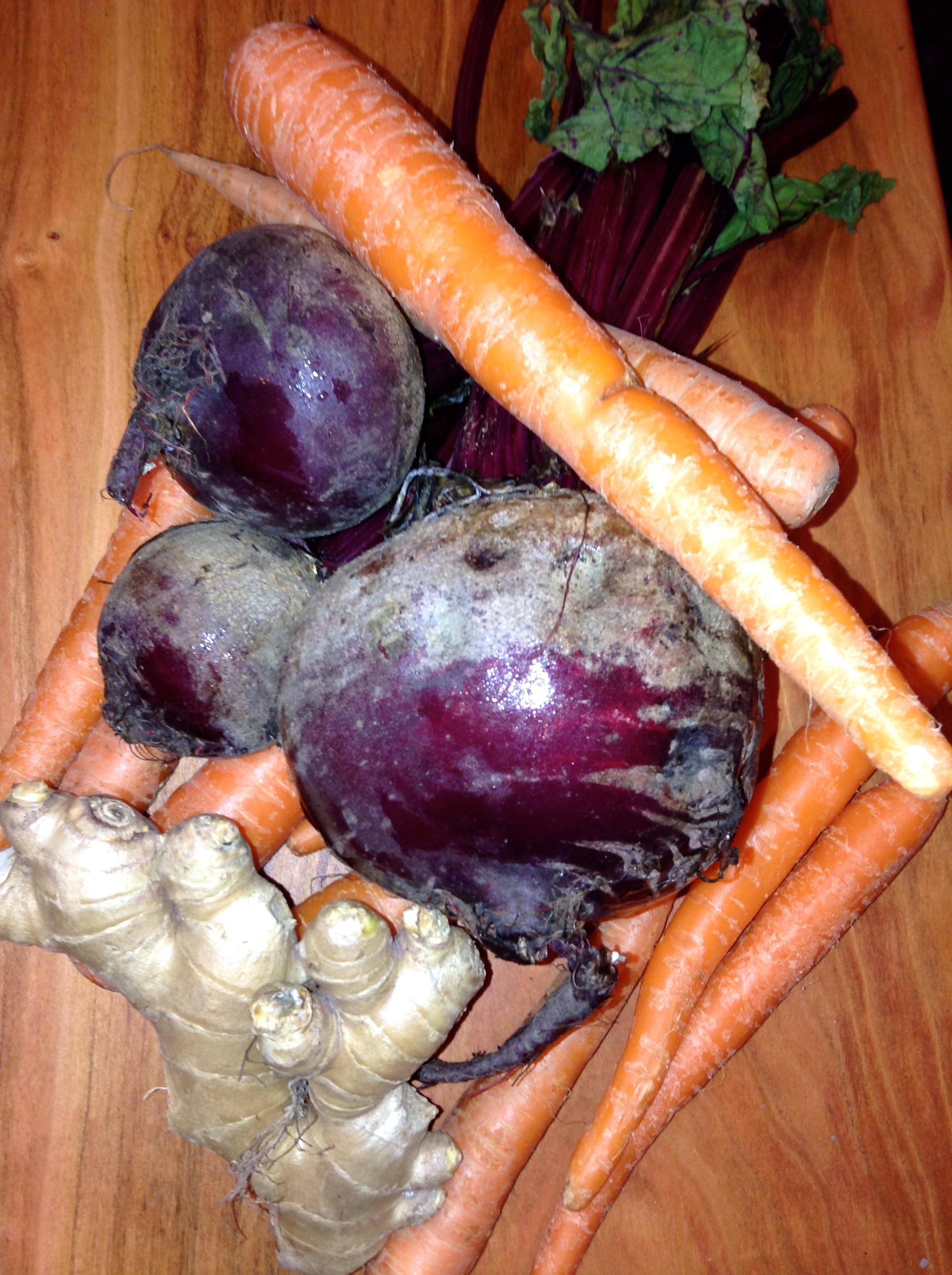
garden beet salad


IMG_3591

Do not say “this happened by chance, while this came to be of itself.”  In all that exists there is nothing disorderly, nothing, indefinite, nothing without purpose, nothing by chance…. How many hairs are on your head?  God will not forget one of them.  Do you see how nothing, even the smallest thing, escapes the gaze of God? ~Saint Basil the Great


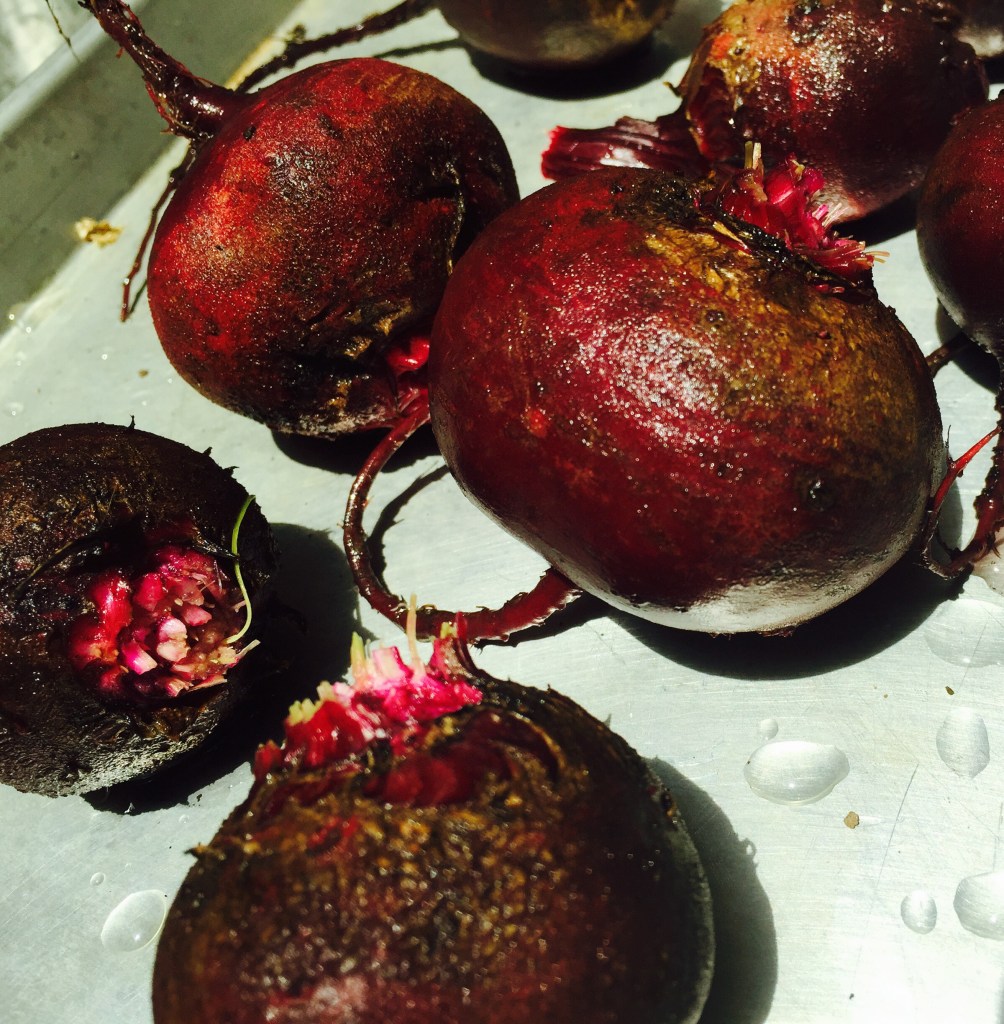
During the summer, we crave salads.  They are a nice cool addition to any meal, or can be served as a meal on their own.  You simply can not “beet” the simplicity of a garden beet salad.  These particular beets are gems straight from our garden, but any from the store or farmer’s market will do.  We planted these in early spring.

I actually hadn’t planned to harvest them, but I accidentally pulled one out while weeding…  it looked so good, that we harvested the rest from that bed!  Beets have a sweet earthy flavor, and are a mineral rich nutritional powerhouse.  They have more iron than spinach, and are an excellent source of calcium, magnesium, copper, and phosphorous.  They’re also packed with  choline, folic acid, iodine, manganese, organic sodium, potassium, fiber and carbohydrates (in the form of natural easily digestible sugars).   Quite simply, they are superfood.

One great benefit of the beet is that is alkalizing to the body and that’s great news in a nation with a standard diet that is acid forming.  Beets are a stimulator of liver health.  They also have many cardiovascular benefits.  They can be helpful in reducing cholesterol and their rich potassium content benefits blood pressure.  Fermented drinks like beet kvass have been known throughout history as a blood tonic.  And the list goes on.  Some studies have also shown that beets are preventative for skin, lung and colon cancer, they support the structure of our capillaries, and can also aid in the slowing or prevention of macular degeneration.

Beets, they do a body good!


Garden Beet Salad

Ingredients:

  • 9 beets, washed but not peeled
  • 4 tablespoons goat cheese in small chunks to drop into salad
  • 3 tablespoons pinenuts, slightly toasted
  • 1/4 cup  finely chopped red onion, green onion tops or chives
  • 3 tablespoons olive oil
  • 1 tablespoon rice wine vinegar
  • sea salt and pepper to taste

Preheat oven to 350F and place beets on a cookie sheet.  Top loosely with foil and place oven for about an hour.  They should be tender.

Remove from oven and let cool.  Once cool, using the edge of a knife or a vegetable peeler, peel of the outer skin of the beet.  Your hands will get very red!

Next, cut the beets into bite sized pieces.  Place all ingredients into your favorite salad bowl and toss lightly to incorporate.

Delicious!


Additional Resources

http://www.whfoods.com/genpage.php?tname=foodspice&dbid=49


massaged kale salad

massaged kale salad

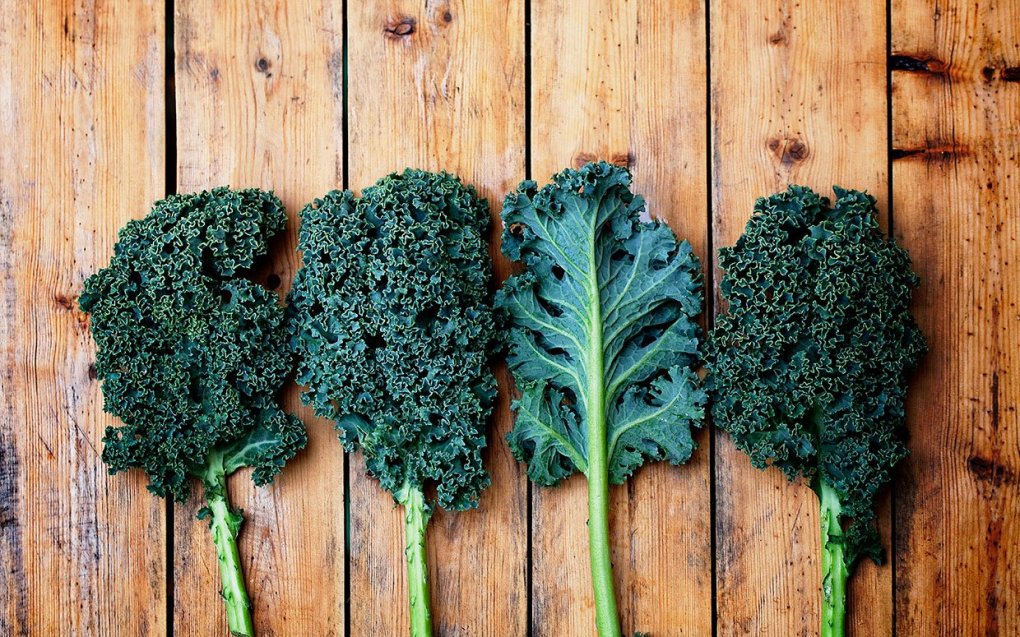
This Massaged Kale Salad is one of my favorites, especially when there are fresh strawberries in season at the market.  Fresh picked strawberries are a sweet addition to the earthy kale and the citrus dressing.  Kale is a superfood that deserves room on every plate.  Most recipes for massaged kale salads call for green apples or other fruit, but I think the strawberries are the best.  Massaging the kale in an olive oil, lemon and salt dressing has the effect of cooking the kale.  The lemon also makes the iron content in the kale far more bioavailable (that means you absorb more!).

I hope you enjoy this kale salad!

[box]

Massaged Kale Salad with Farm Fresh Strawberries

  • 1 bunch fresh kale, washed
  • 1-1/2 cups fresh organic strawberries (from the farmer’s market is the best)
  • 2 tablespoons olive oil (expeller pressed)
  • 1 teaspoon sea salt
  • 1/4 cup minced red onion
  • fresh juice of 1/2 lemon
  • optional : 1/2 cucumber, cut into small cubes
  • optional : 1/2 cup toasted sunflower seeds,  slivered almonds or pine nuts
  • optional: 3 teaspoons fresh oregano or marjoram finely chopped

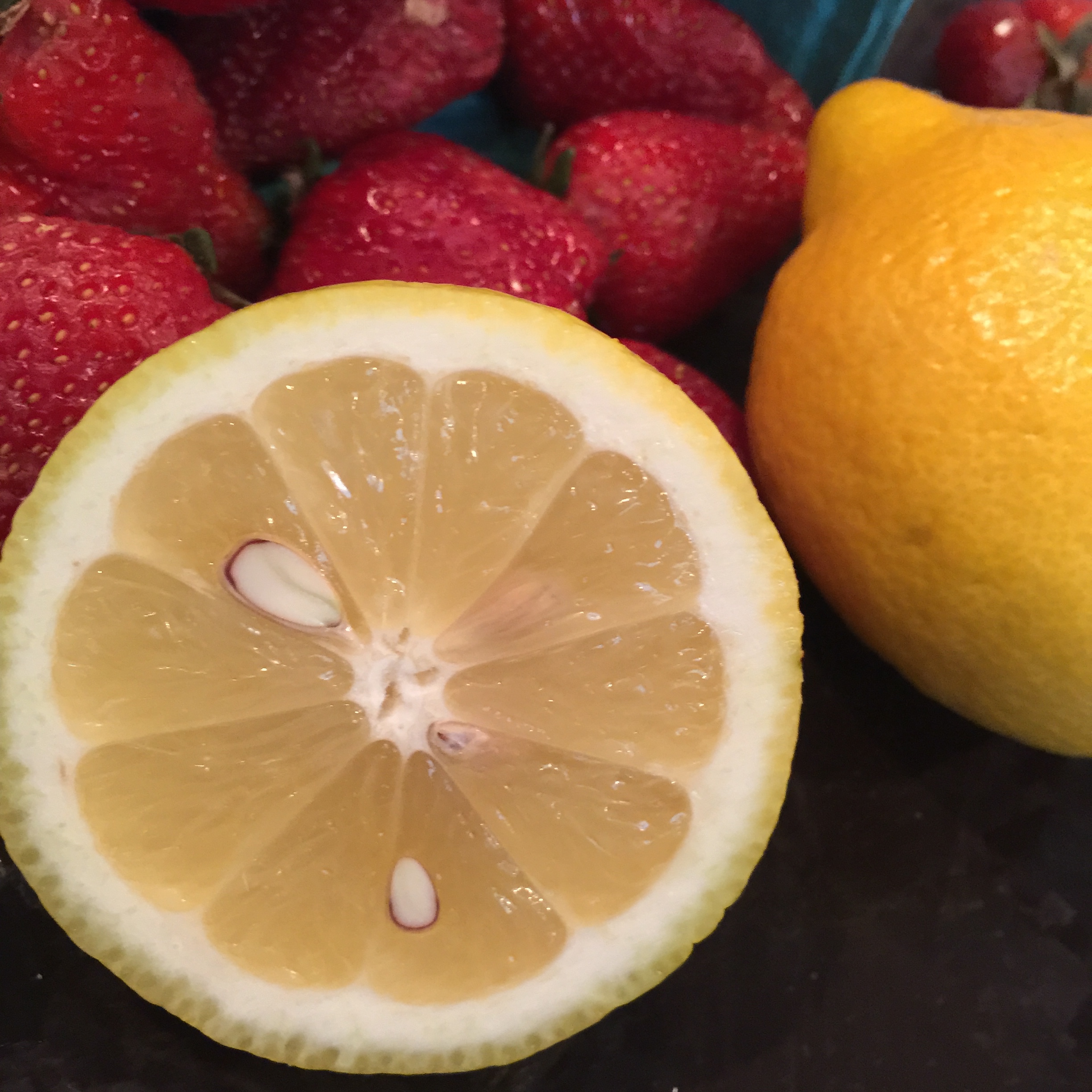
Gather your ingredients.

strawberries and lemon

Stem and chop the kale.   Place in large bowl and drizzle with olive oil, lemon juice and salt.

Massage kale gently with your hands for five to ten minutes.

IMG_1092


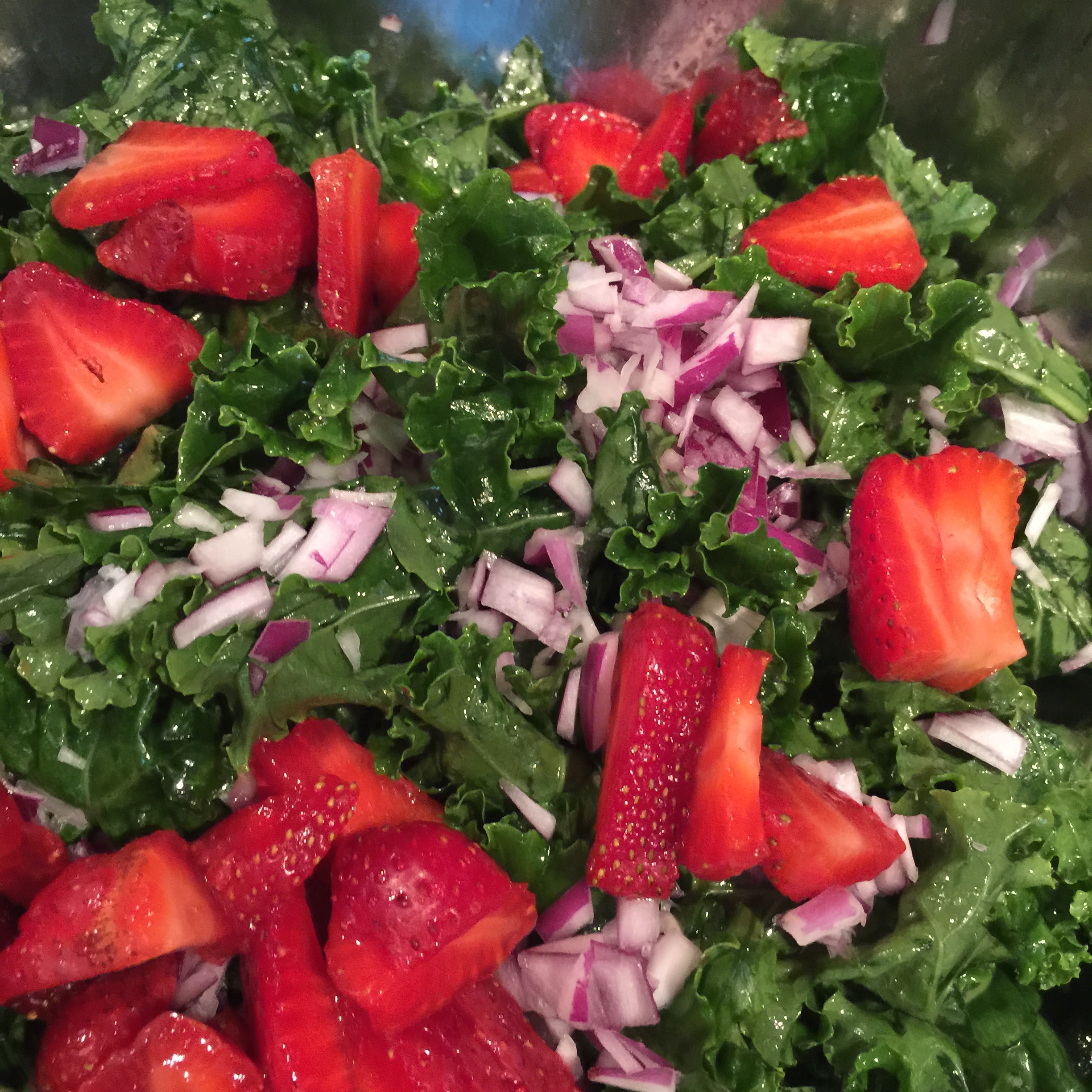
Toss with the strawberries, onion and other optional ingredients  (if using).

[/box]

Enjoy!


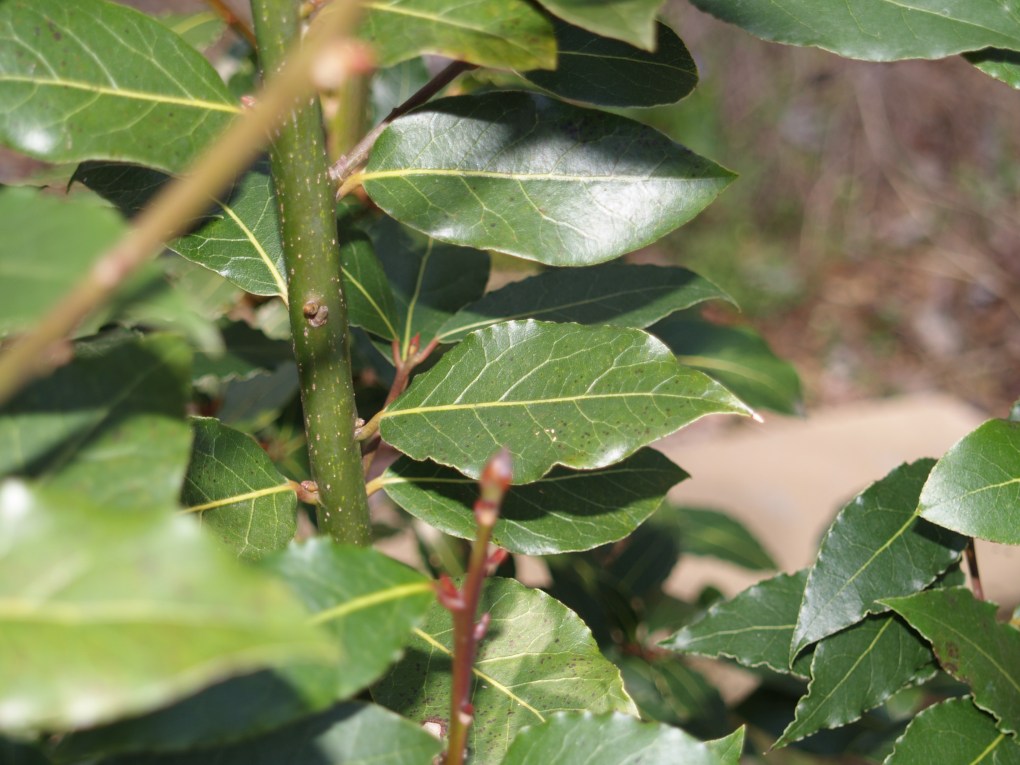
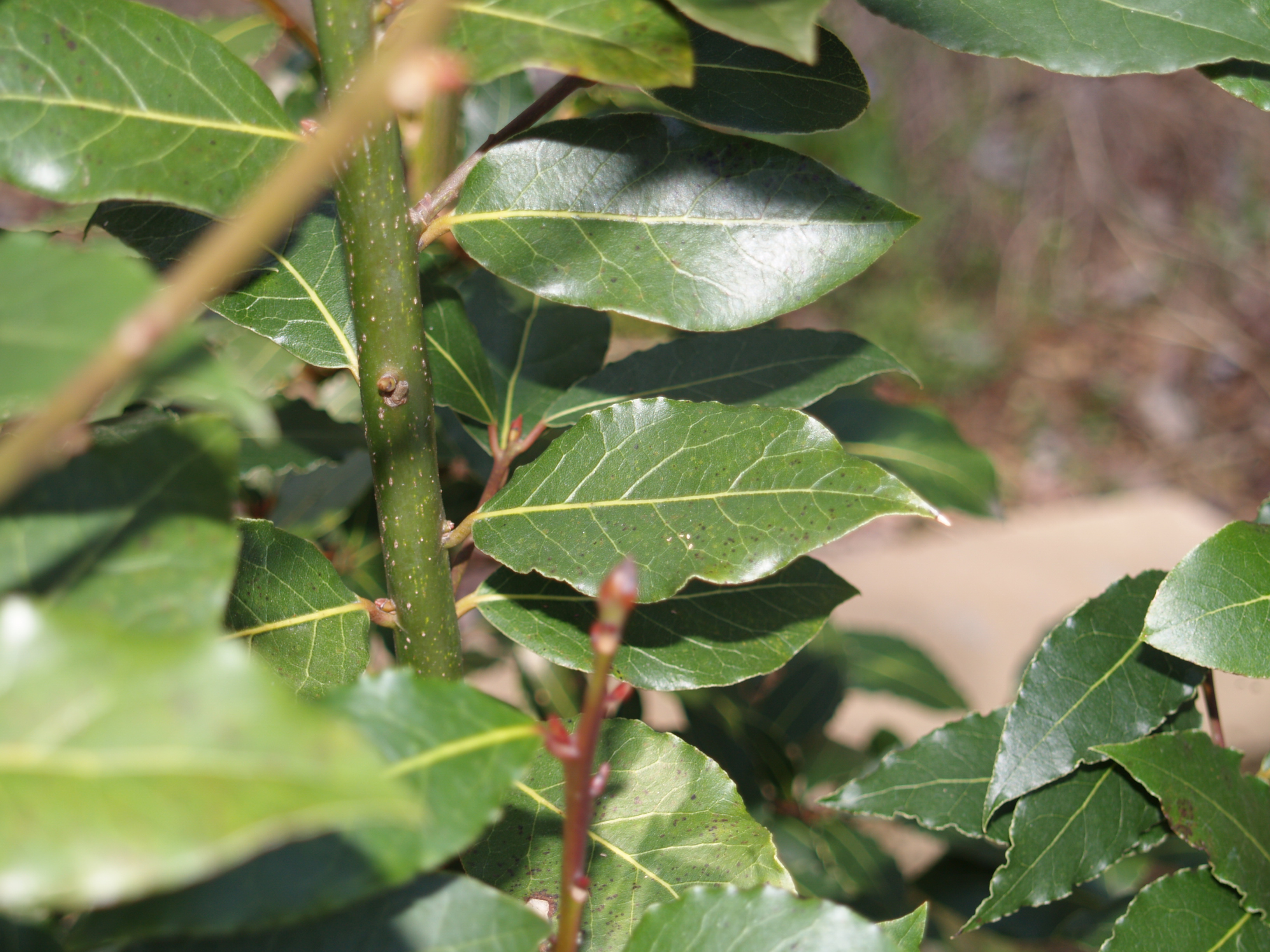
bay laurel

bay laurel 2014

In Biblical times, the bay laurel was symbolic of wealth.  It is a lovely tree , native to the Mediterranean, with soft branches and grows to about 10 -20  feet in height.

What is most notable about the bay leaf is the sweet aroma of the leaves – it has a mellow sweetness that smells a little bit like Christmas.  Ancient Greeks and Romans adorned their Olympic victors and heroic soldiers in wreathes fashioned and twined out of bay branches.  King David was so taken with the bay laurel that he used the aromatic bay wood for paneling his personal rooms.

Nowadays, the bay laurel is used mostly to season mediterranean dishes – from meats, fishes and poultry to vegetables, broths and soups, and stews.

We have a bay laurel tree in our herb garden, that was bought over a decade ago at the farmer’s market.  At the time, I didn’t know that you could grow your own bay tree, but my good friend bought one, and I followed her lead.  The young trees do not do well in cold weather, so it grew in our home by a sunny window for about 7 years before planting it outside.    Then last winter, we had such cold weather for our area – in the twenties for many many weeks.  The branches and leaves all got the equivalent of frost bite and dried up and died.  So in the spring we pruned our beautiful tree down to the stubs and hoped for the best.  Guess what, it grew right back!  The picture above is from the beginning of summer.


The bay leaves can be used in tea or as a culinary herb, but the bay has some other surprising properties.

[box]

Herbalists have known that bay laurel poultice or wash may help increase the healing of wounds.  Science has finally gotten around to confirm it.  A 2006 study in the “BMC Complementary and Alternative Medicine” journal found that rats treated with 200 mg of bay leaf extract per kilogram of body weight experienced accelerated wound closure and healing within 10 days.”

The essential oil from the bay laurel is bactericidal and fungicidal.  A 2011 study in the journal “Natural Product Research” discovered why — bay leaf extract was found to have antimicrobial activity against some of the most common pathogens, including Staphylococcus aureus, Streptococcus pyogenes, Aspergillus fumigatus and Candida albicans.

The oil from the bay laurel has been used for soap making and veterinary medicine.

The bay leaf is a primary ingredient in “gripe water” which is a natural remedy for colicky babies!  So it is no surprise that in Lebanon, bay leaves are extracted to relieve flatulence and act as a stomach tonic.

Also in Lebanon, bay leaves are steeped in brandy and let to sit in the sun for several days.  The residue, after distillation is used for arthritis and sprains.

[/box]

You don’t need to grow your own bay tree to enjoy this aromatic herb, but if you’d like to and are in Virginia – Monticello – home to President Thomas Jefferson sells them for a reasonable price, and you can tour the mansion while you are there too!   Another great place for anything plantable and edible is Edible Landscaping.  They also sell bay laurel.

If you’d prefer to buy it harvested, then my best recommendation for it is Penzey’s.  Their spices are super fresh and also very affordable.  I first heard about them in Cook’s Illustrated magazine.  My good friend, the one who originally encouraged me to buy that little bay tree, and I -when we were very young stay at home mom’s – used to buy our spices in bulk from Penzey’s and split them.

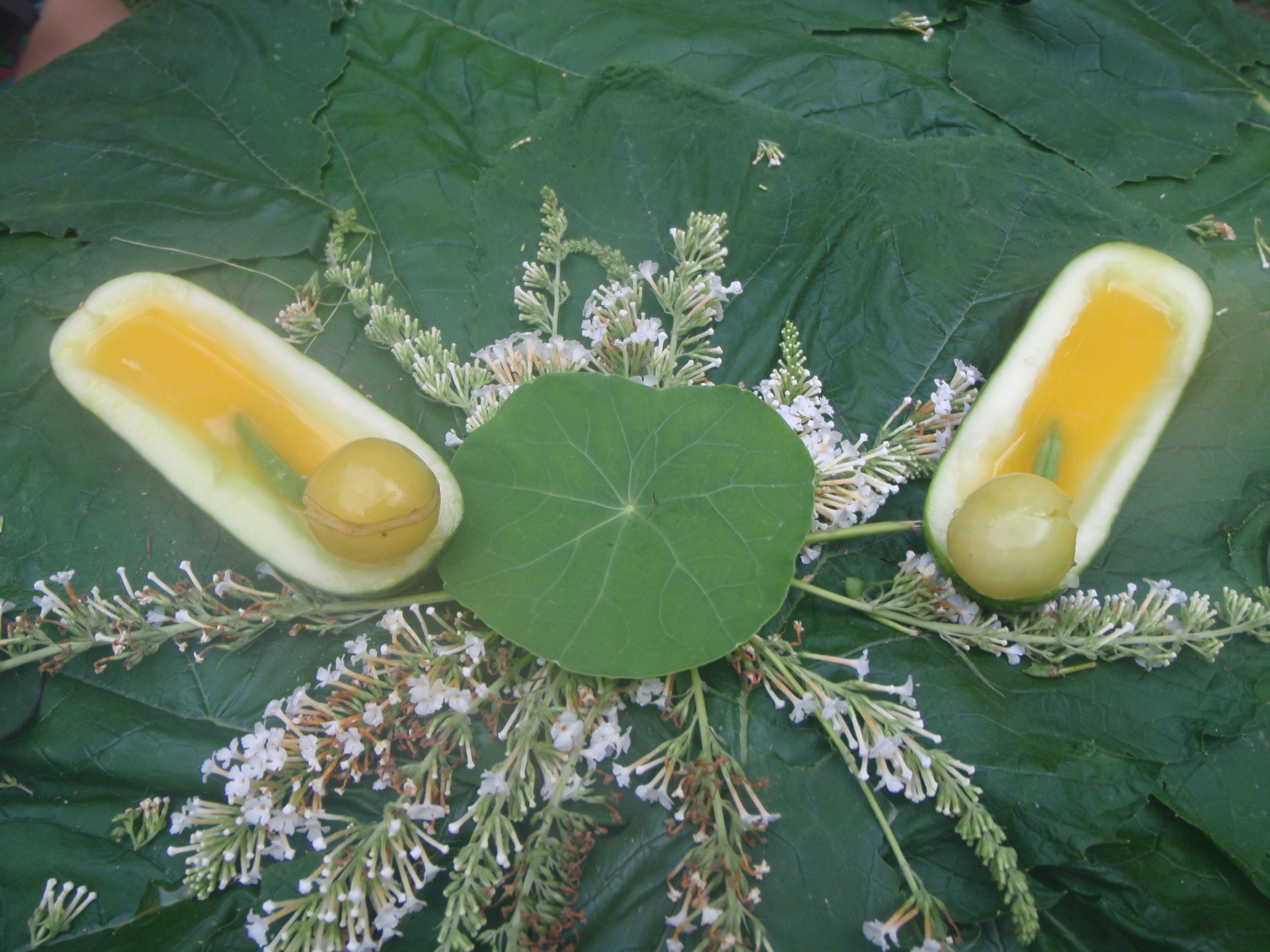
You can use fresh or dried bay laurel for tea.  My daughter, when she was younger loved to play in the garden.  She would make her own tea with bay leaves, lavender and thyme – sometimes it was VERY strong….but still delicious.  She also would take the most ordinary fruits and vegetables and make them into a piece of art.   Like this squash and orange juice platter of sorts that she came up with, served atop of a gigantic squash leaf and enjoyed by her and her sisters and friends.

garden art

This is a modification of my daughter’s playful tea.

[box]

Citrus and Cinnamon Bay Leaf Tea

Ingredients

  • 1 cinnamon stick
  • 4 bay leaves
  • juice of lemon to taste
  • 3 cups very hot water

Place all ingredients in a tea pot and allow to steep for five minutes or longer.  The longer it steeps the stronger the flavors.

Enjoy as is or add some raw honey for a little sweetener.

[/box]

Resources:

http://www.livestrong.com/article/480381-what-are-the-health-benefits-of-bay-leaves/

James A Duke, Ph.D. Herbs of the Bible: 2000 Years of Plant Medicine


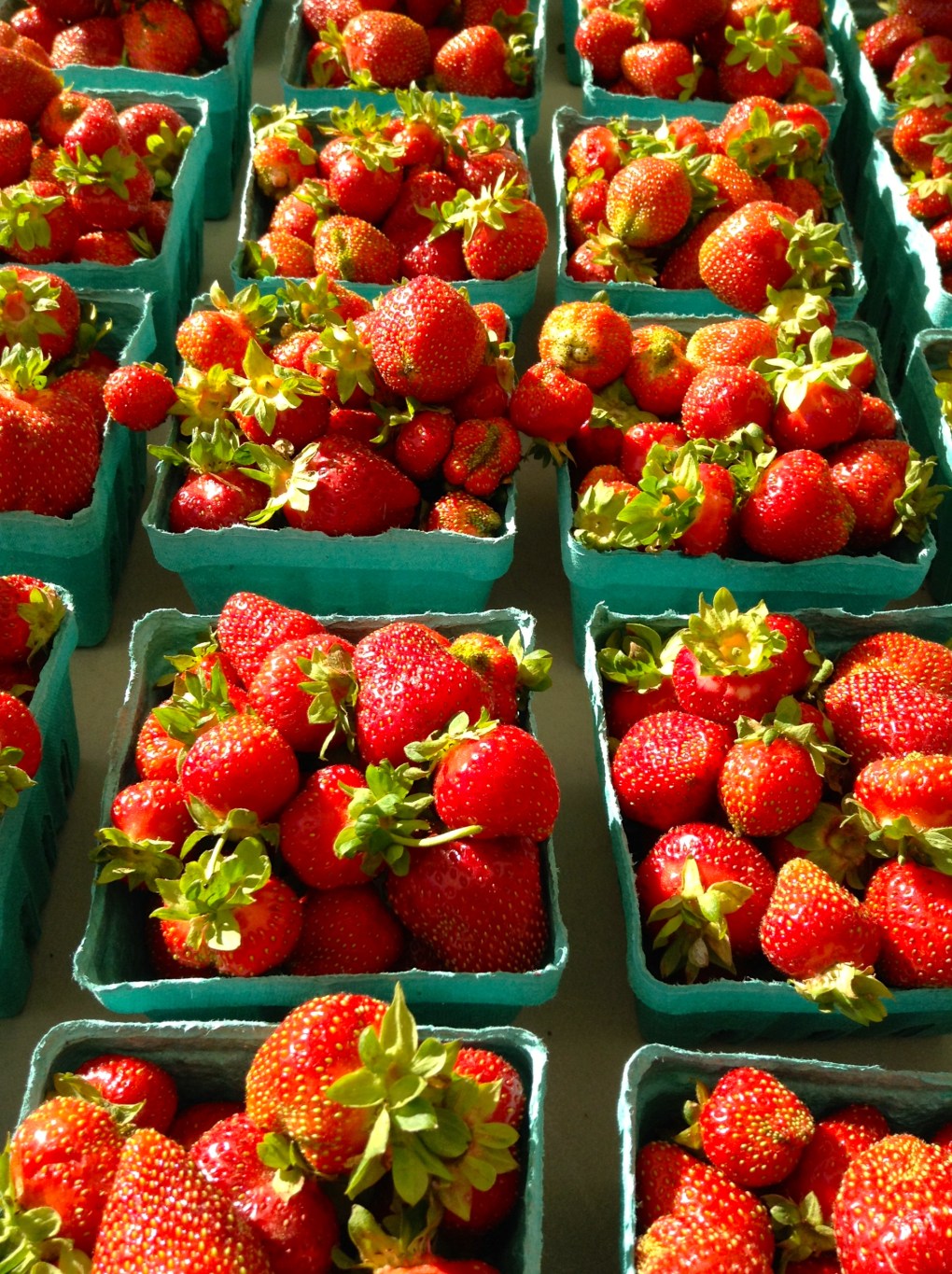
i heart organic strawberries

“For a long time now we have understood ourselves as traveling toward some sort of industrial paradise, some new Eden conceived and constructed entirely by human ingenuity. And we have thought ourselves free to use and abuse nature in any way that might further this enterprise.  Now we face overwhelming evidence that we are not smart enough to recover Eden by assault, and that nature does not tolerate or excuse our abuses.”

Wendell Berry ~ Bringing It to the Table: On Farming and Food


For about a year of college I lived in Germany, which was my first exposure to farmer’s markets, a way of life at least where my family there lives.  That was some twenty years ago – probably about the very time farmer’s markets were gaining new traction in the U.S.  At the time, I’d never seen eggs so fresh they were still adorned with feathers, or vegetables still smelling of the earth.
One thing about fresh food is that it’s always near death ~ counter-intuitively that makes it alive, and allows it to nourish us with all the vibrancy of it’s vitamins, minerals, enzymes and phyto-nutrients (a word apparently so new that my spell check keeps trying to change it).
With that in mind, any one attempting to stay as local to their food sources as possible knows the importance of preserving the harvest.  Fresh food is not immortal!  At the moment we are at the waning edge of strawberry season here in Virginia.  In fact, we missed getting any at the past two markets due to our late arrival, so this morning we got there early!
Making that effort to find the best food for my family is really important.  These are not delicacies or haute cuisine at all, but no-frill foods that are raised in harmony with the land, in such a way as to be nourishing rather than depleting.
If we don’t eat the strawberries we bought this morning in about four days, they will rot.  So, extending the harvest has become a habit allowing us to enjoy the delights of spring even into the upcoming winter.  There are many ways to preserve what’s currently in season from canning, to lacto-fermentation and even simply freezing.
As a rule we try to stick with organic whenever possible, but particularly with strawberries which are a fruit known as one of the dirty dozen.  That’s because they are covered with some of the most toxic agricultural chemicals available.   Many of these chemicals are carcinogenic and known endocrine disruptors – that means they mess with your hormones.   Nice!   Even after washing, 67% of fruits and vegetables sprayed with these chemicals still contain them.  Hmmmm.
Over time, many of these toxins bioaccumulate in our fat cells.  Our bodies really do not know what to do with these, and that can have negative effect on our physical health.
The blessing of the farmer’s market is being part of a community.  People get to know one another and look forward to chatting, sharing and learning. You know your farmer’s name, and feel confident in his word.  None of our local strawberry growers sprays, which is a testament to their dedication and nurture of the land.  It’s all connected…in providing well nourished soil to the plants, the plants then become strong and less susceptible to disease and pests, which means these farmer’s don’t need all of the toxic pesticides and fungicides in the first place.
Buying organic can seem more expensive – perhaps in the short run it might slightly be – mostly because we buy en masse.  That said, at the farm stand I can pretty much guarantee you will get a discount  – most of the time without even asking – if you buy in bulk.

This slideshow requires JavaScript.

Whether you freeze them, make them into jams, pile them atop of shortcake or eat them right out of the flat, they are a seasonal delight that brings a smile to everyone’s face!

contain yourselves

“Odd as I am sure it will appear to some, I can think of no better form of personal involvement in the cure of the environment than that of gardening. A person who is growing a garden, if he is growing it organically, is improving a piece of the world.”  Wendell Barry – The Art of the Commonplace: The Agrarian Essays


Even if you have only a tiny patio or balcony, growing your own food is a possibility.  No matter how little space you have, with a packet of seeds, a few pots or other container of your choice, you can turn a blank space into an edible landscape.  Whether you grow an assortment of kitchen herbs or potted potatoes, carrots and beans it’s easy and can transform an urban space into a haven and retreat.

A few weekends ago, we picked up some cedar planters at our local plant store DePaul’s Urban Farm and then the kids got to work staining them and planting some carrots.

This slideshow requires JavaScript.

Soon we will have an awesome harvest of carrots.

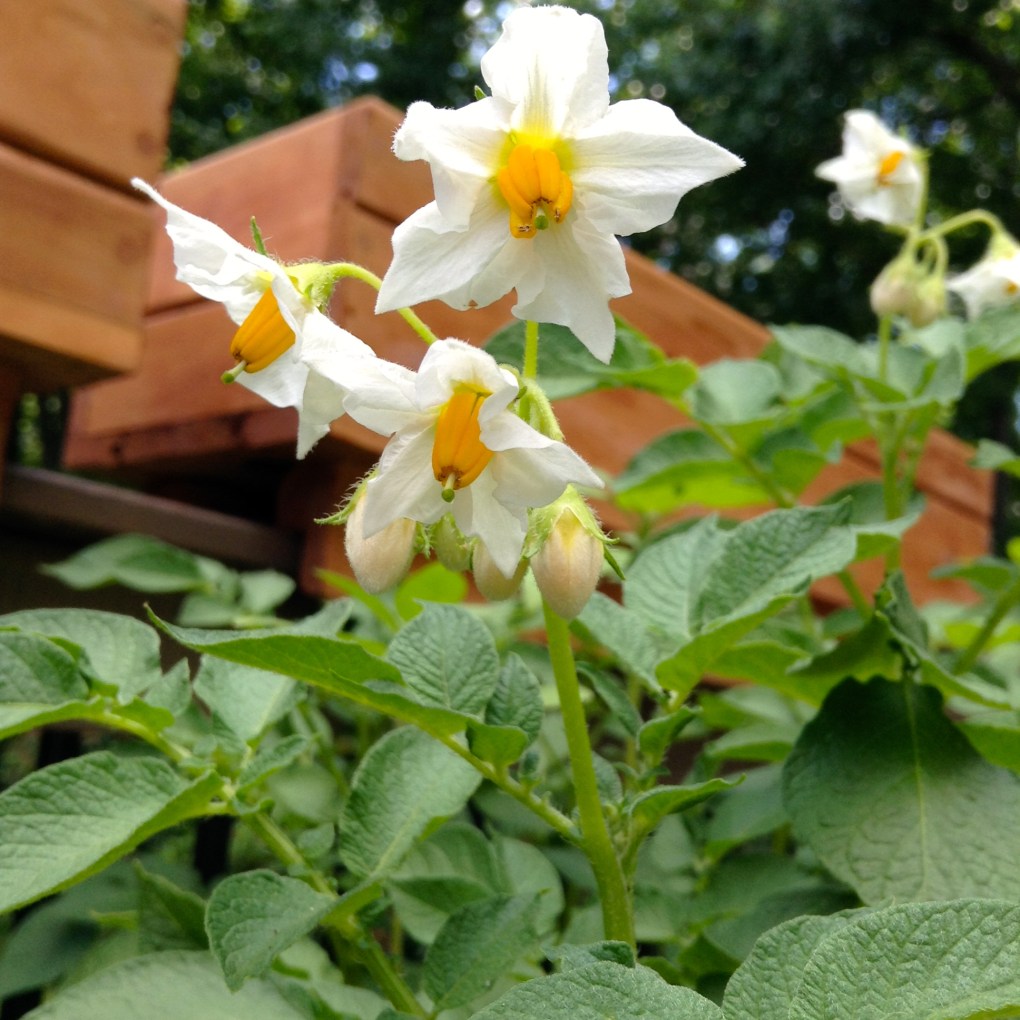
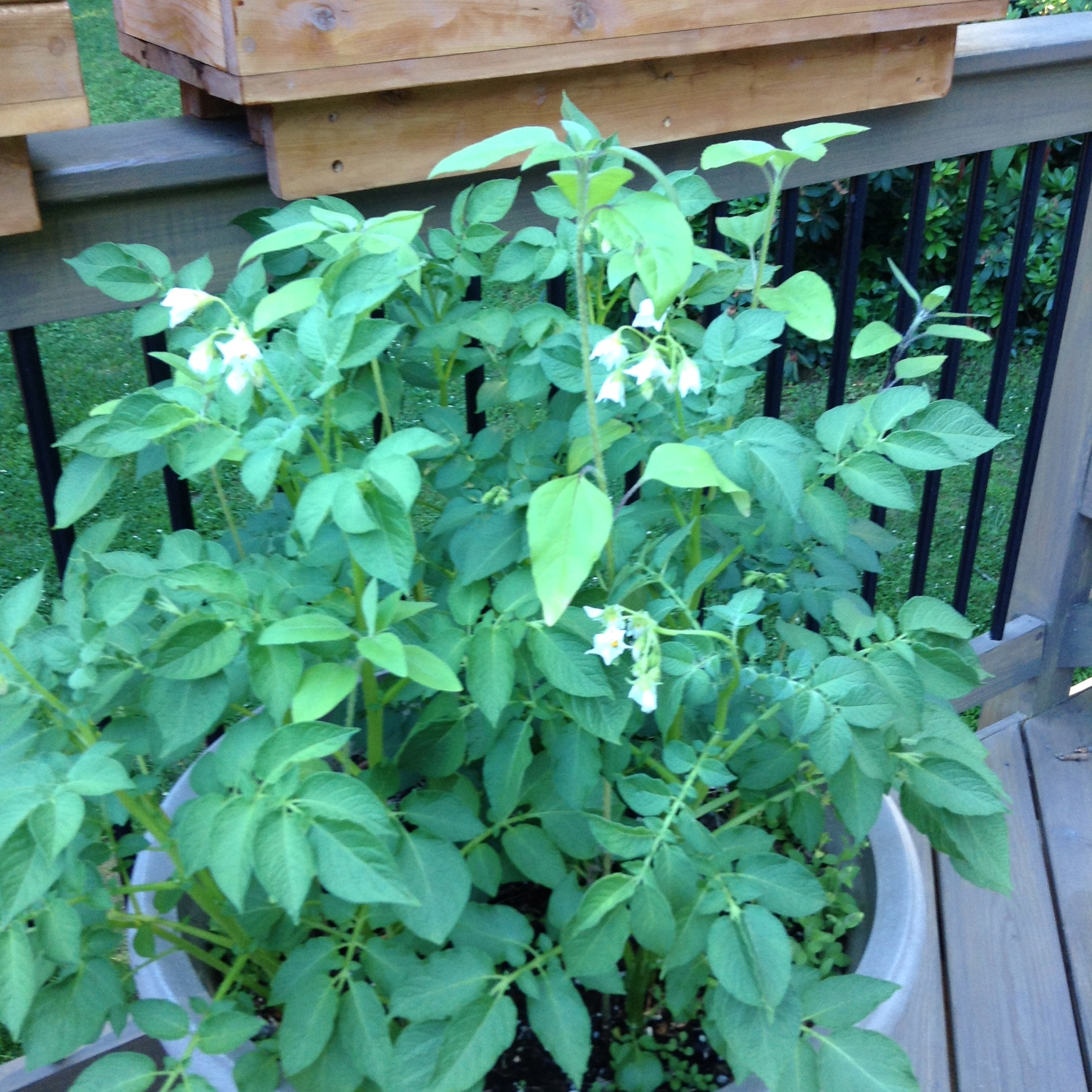
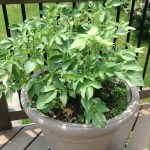
Also too we have potted potatoes – so much easier to harvest because they are confined to one space than planting in a larger garden.  For something a little different we added sunflowers into the mix – for a little flowery effect.  They will bloom soon!

Whatever you chose, the main thing is to have fun with your planting and make a space which is visually and edibly pleasing.

At the end of the day, nothing compares to your own fresh grown food.  Just as wonderful is that you really don’t need a lot of expertise or skill to grow them – especially beans, tomatoes, peas and any salad vegetable.

IMG_0286

The past ten years have seen a rapid increase and high demand for real local sustainable food.  Not a new idea, just one misplaced for about a century!… previously all food was local, mostly because there was not the ability to transport it, or the chemical fertilizers to mass-produce it.

Family gardeners restore and heal their little part of the world starting with their own space and being.  Working the dirt, it is inevitable that knowledge, experience and success from those lessons unearthed in the garden tills into other areas of our lives ~ gratitude and thanksgiving for the harvest, family and friends!

“In almost every garden, the land is made better and so is the gardener”. ~Robert Rodale


grow.harvest.enjoy

In farming, as in gardening, I happen to believe that if you treat the land with love and respect, then it will repay you in kind.  – Prince Charles

The life of a garden is in perpetual motion.  It’s a dynamic place, hustling and bustling with the growing harvest and buzzing with life.  It’s a place were nature thrives and in so doing nourishes hungry family and friends.

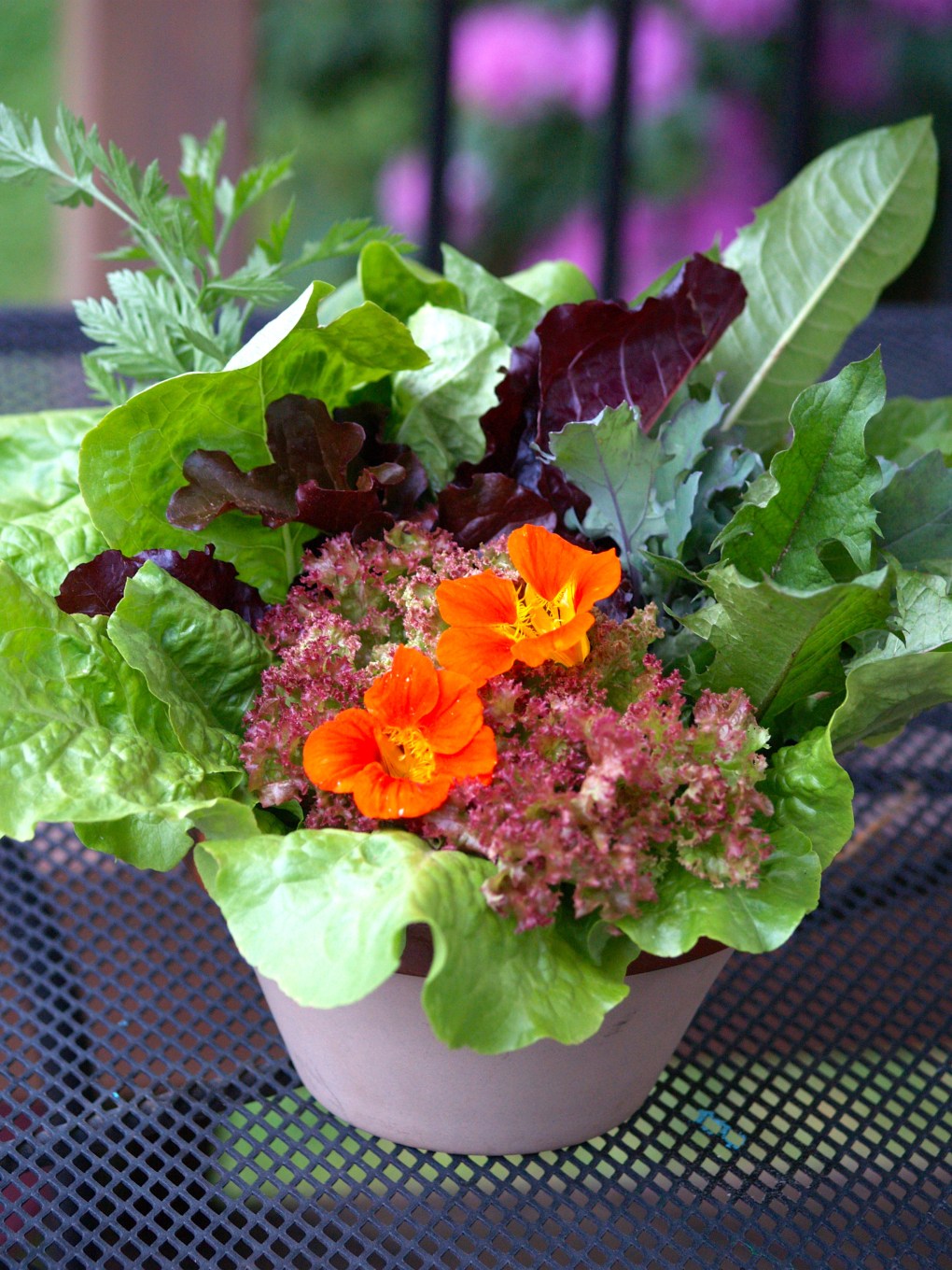
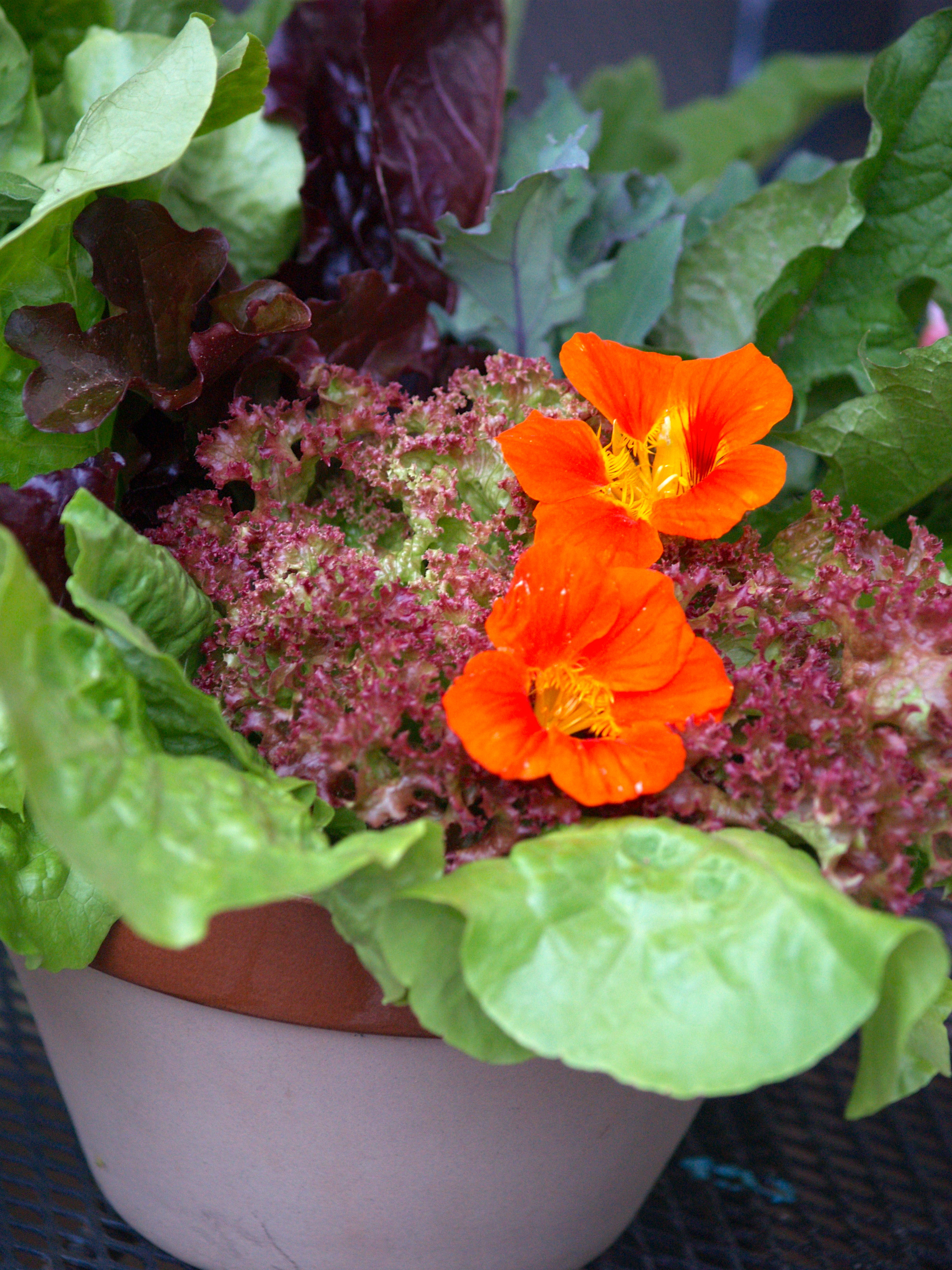
This beautiful bouquet is not a gift from my husband, but our dinner salad!  Full of an assortment of fresh salads from the garden as well as carrot tops, baby kale, dandelions, cilantro and peppery nasturtiums we snipped it just before dinner and it is a crispy delicious addition to our meal.

Growing your own organic vegetables is practical in many ways – from reducing use of fossil fuels and exposure to toxic chemicals to increasing the vitamin content of your meals  – although as modern consumers “organic” seems a relatively new concept, this is how our great grandparents gardened.  They didn’t “certify” it or have any special name for it.  Caring and nurturing the land was just a way of life – and in return the earth gave sustenance for their nourishment.  Our forefathers had a greater understanding of healthy soil and plants than do we.

In my own family, it was my German grandmother who gave me a love of gardening.  She tended her little plot of backyard garden with a vibrant happiness and care – even to the point of setting aside water in the morning and waiting a few hours to hydrate the plants so that it would warm to the air temperature.   I am not sure of whether that made any difference to the plants, but I can say that hers were some of the best beans and tomatoes I’ve ever had and she always had a very high yield.  But the point is that small farmers tend the planet better than big business.  Small farmer’s and family gardeners work in harmony with the seasons and Mother Nature rather than fight her and that makes all the difference.

If you are not sure about growing your own food, but are thinking to give it a try – remember that it’s not necessary to have a green thumb.  Seeds want to grow.  Even if you make mistakes, you’ll learn from them and that is a great blessing!   The best part is that your little victory garden will give you the chance to reacquaint yourself with all you thought you knew, from radishes to carrots to kale.  Cultivating the land gardeners cultivate patience – the joy of waiting to taste  a strawberry or sugar snap pea and also forgiveness for the imperfections those natural and organic sometimes yield – while not always perfectly shaped they are always delicious!  In so doing a gardener also learns a little something about life and community.


Dinner Bouquet


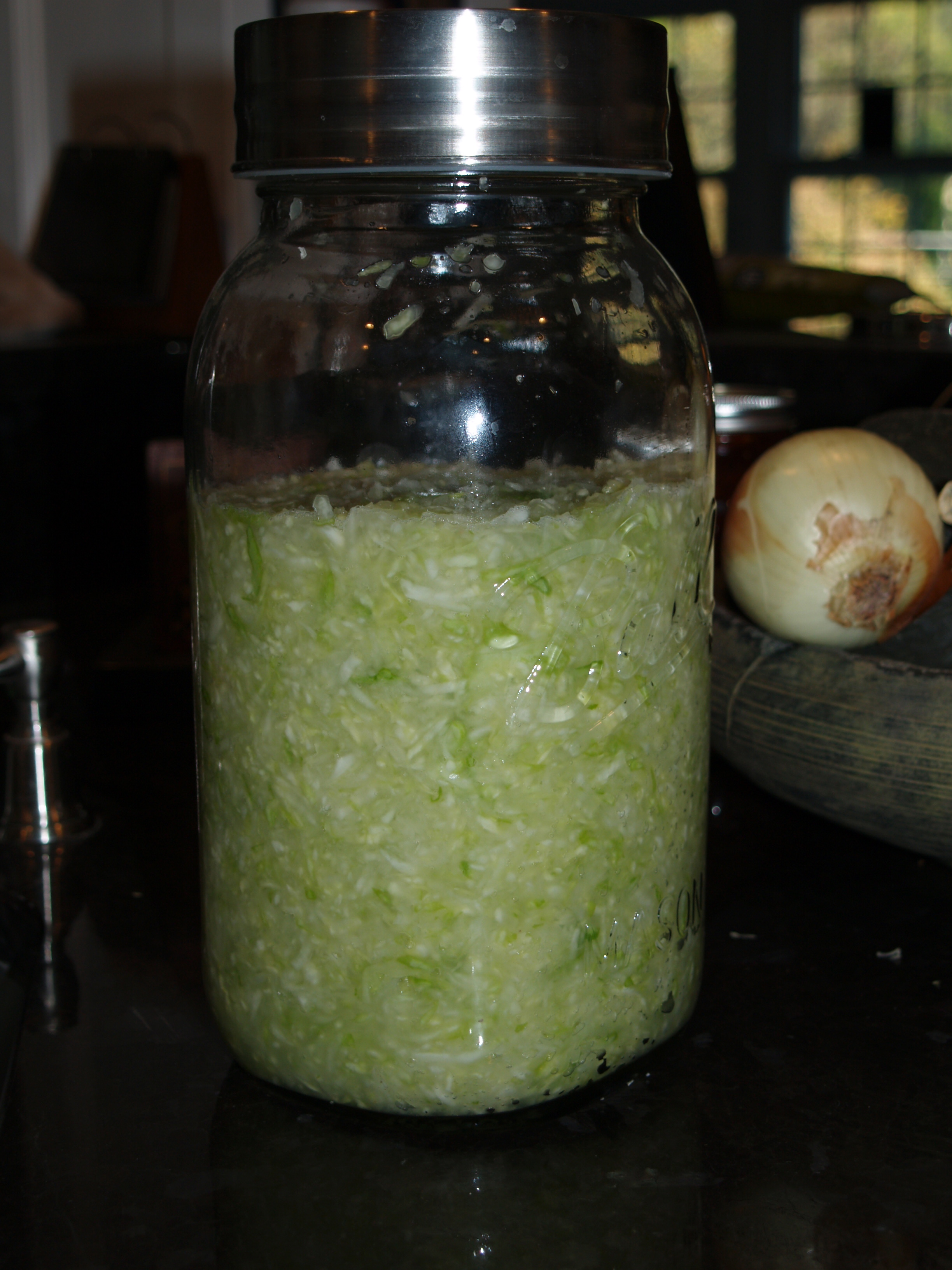
sauerkraut

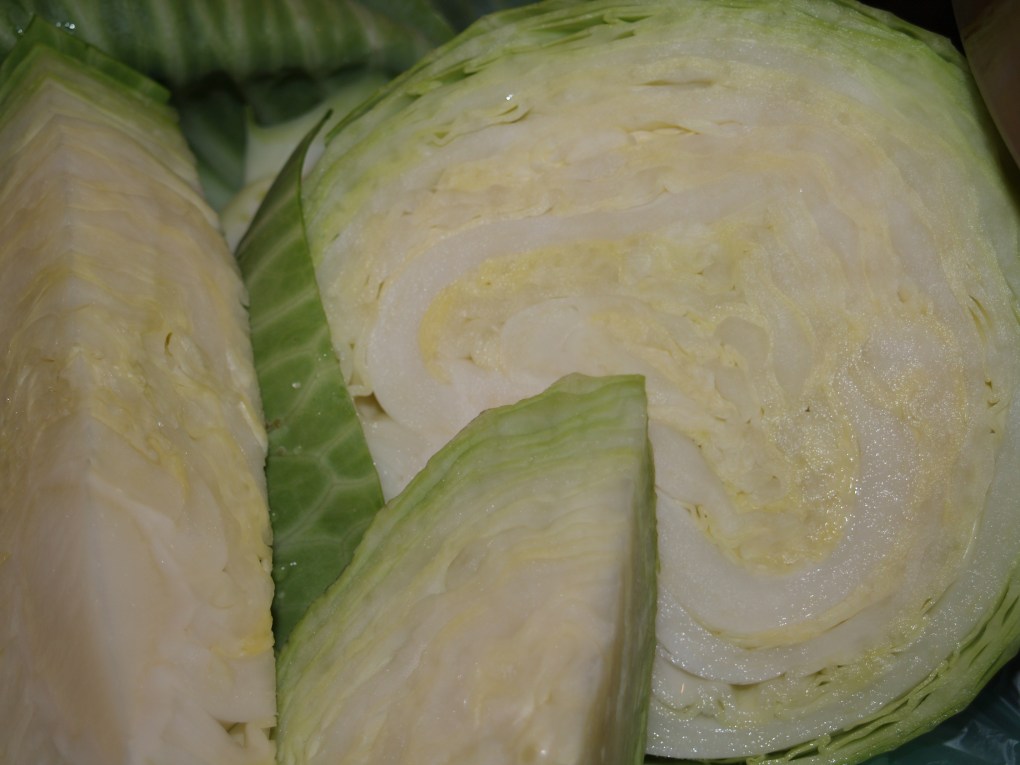
Farm Fresh Cabbages

“I have come to the conclusion that the most important element in human life is faith.  If God were to take away all the blessings, health, physical fitness,  wealth, intelligence, and leave me with but one gift, I would ask for faith— for with faith in God, in God’s goodness, mercy, love for me, and belief in everlasting life, I believe I could still be happy, trustful, leaving all to God’s inscrutable providence.” —Rose Kennedy


Most people would agree that we live in a germ-ophobic country.  YET, all around us and within us there is a microscopic world, things invisible – an interconnected multitude of fungus and bacteria.  (uh-oh…)  From the beginnings we coexisted with these little organisms; we even harnessed their help to age and preserve our food without refrigeration.  However, when Louis Pasteur uncovered the role of bacteria in disease, (which is a great thing!) we began to fear them as dangerous enemies and in fearing them we forgot about their role in health.

Not all bacteria and fungi are bad.

In our modern antiseptic world, it can take a leap of faith – and maybe even a little science – to calm our fears, reacquaint ourselves and get comfortable with the microcosmos around and within us.  A little reminder that the world God created is good  (it was also raw and unpasteurized, by the way!) and that I can rely on that whole food creation -more than food scientists and industry- for the plentiful nourishment of my family!   You know what?  So can YOU!

The word sauerkraut is German for “sour cabbage” – but the French call it choucroute.  Whatever you call it, sauerkraut is probably to most widely known fermented food behind, pickles, olives and yogurt.

Probably the most widely known sauerkraut is Bavarian style, which is shredded cabbage, salt and seasoned with caraway seeds.  Some other German styles use juniper berries to season the kraut.


A word on the nutritional virtues of sauerkraut.


Fermented sauerkraut is not only pre-gested thereby making it’s nutritional profile more bioavailable, it is also low in calories, high in fiber, and is a good source of vitamins K, C and folate and also the minerals potassium, calcium, magnesium, copper, manganese and iron.  It has a great profile of antioxidants and is anti-inflammatory.  Cabbage is exceedingly nutritious on it’s own merits, but let it ferment and it’s full potential is silently revealed.

Studies that “analyzed cabbage before and after fermentation to see how the elements had changed  found that the glucosinolates in cabbage dissolved into a class of enzymes that have been shown in prior studies to prevent cancer.” (Preventdisease.com)

But that’s not all!  Sauerkraut also helps to maintain the acid/base balance of the body, helps to regulate blood sugar levels making it useful for hypoglycemics and diabetics and has been associated with preserving ocular health.

Like all ferments, sauerkraut  is high in naturally occurring lactic acid which helps maintain a healthy acidity in the large intestine, thus creating an environment that is hostile to parasites  and yeast but comfortable for good bacteria.


Ready to give it a try?


Fermentation takes neither much time, or effort.  It’s a great way to add great nutrition to the table, and making it yourself is a real money saver when you’re on a budget and feeding a large family.

It’s super nourishing, unassuming and delicious.  We eat it because it tastes great.  On it’s own, adorning a brat or hot dog, or even as a great garnish on a wintery day’s BLT.  You can buy sauerkraut in the store, but if you want all the benefits of the ferment, then it’s best to look for small batch, artisinal, organic, lacto-fermented varieties that are also non-pastuerized.

 

IMG_0306


Michael Pollan says about fermenting, “Koreans, who know a thing or two about fermentation, distinguish between the “tongue taste” of various foods and the “hand taste“.  Tongue taste is a simple matter of molecules making contact with taste buds – the kind of cheap and easy flavors any food scientist or food corporation can produce.  Hand taste is the far more complex experience of a food that bears the indelible mark – the care and sometimes even the love – of the person who made it.  The sauerkraut (and most anything else) you make yourself will have hand taste.

That makes a lot of sense here at Nourishing Grace, because the word nourish is quite beautiful and comes from the latin nutrire, which means to feed or cherish, to preserve, look after or suckle. That implies a “hands on” relationship!


“Better is a dish of herbs where love is than a fattened ox and hatred with it.” —Proverbs 15: 17


Of all our nourishment let it be rooted in goodness and love as we prepare and enjoy our meals with loved ones at the table!


how to make your own sauerkraut

Equipment

1 – 1 gallon Ceramic crock or  wide mouth mason jar

plate or plastic that will fit inside


ingredients for sauerkraut

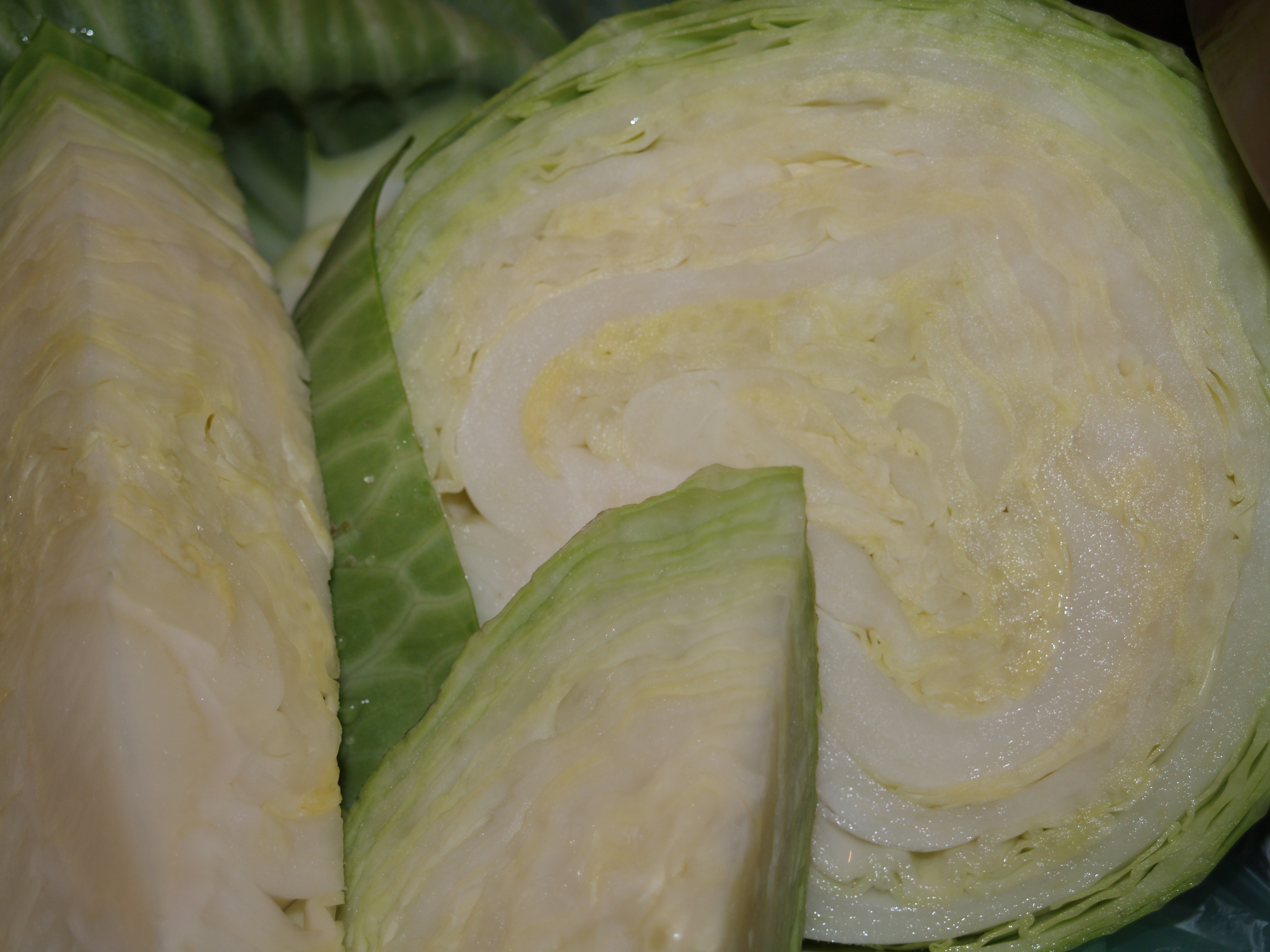
2 medium heads fresh cabbage (fresh local cabbage is the best because of it’s higher moisture content the salt will draw out more water for the brine.

3 tablespoons sea salt


process

chop or shred the cabbage.  We use a food processor

As you process the cabbage, place in bowl and sprinkle salt on each layer.  The salt osmotically draws the water out of the cabbage.  This becomes the brine in which the cabbage ferments without rotting.
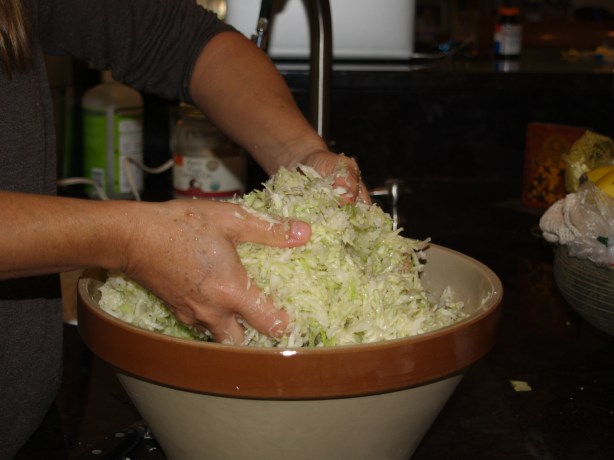
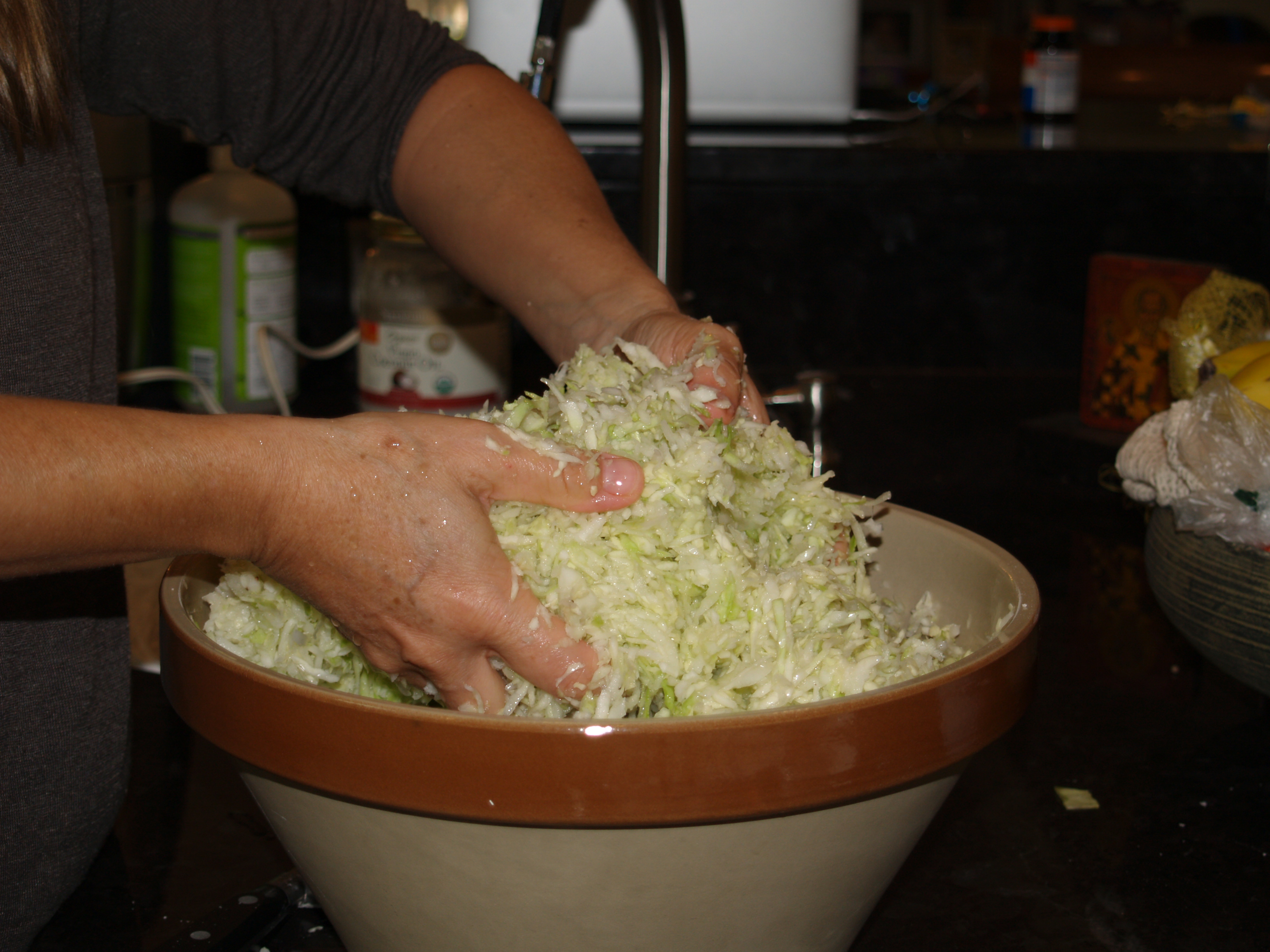
mixing the sauerkraut

mixing the sauerkraut


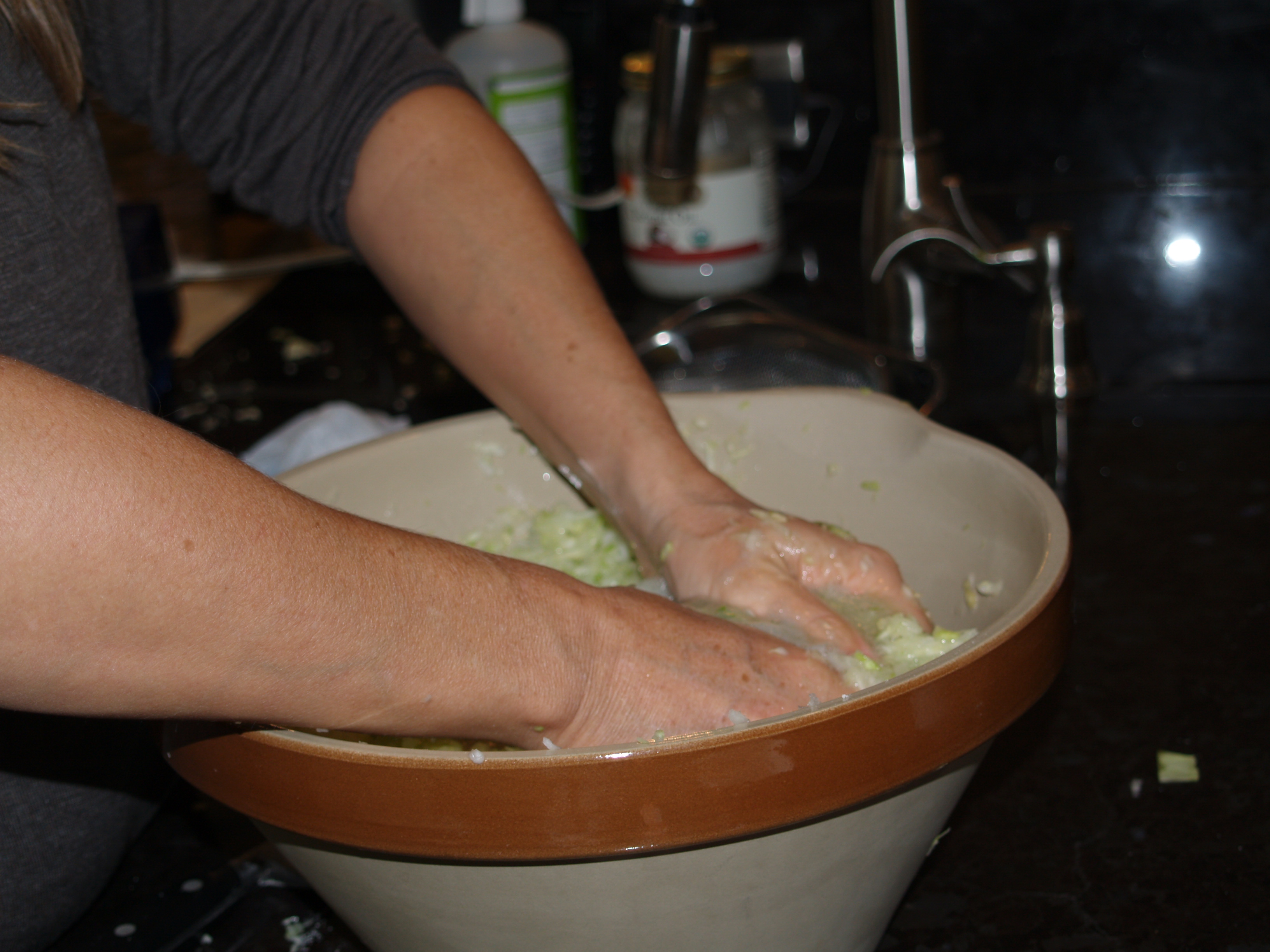
Mix the ingredients together and you can either pound the cabbage, or massage with good firm squeezing.  That will all serve to draw out the brine.  You can also mix it and leave it for a half an hour and then start the pounding or massaging.
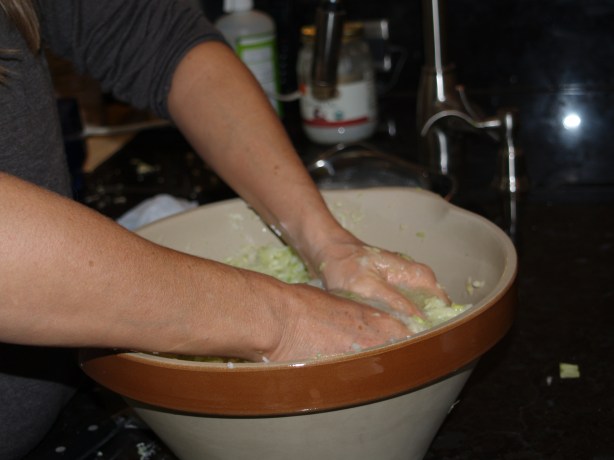
 

massaging the cabbage

massaging the cabbage


Transfer the mixture to the crock or mason jar.  Tamp it down firmly.  You can use a tamper or your fist.  I use my hands.  Push the cabbage below the brine level.  Fermentation works because the vegetables stay below the brine.  So in this oxygen deprived environment, anaerobic, only the good bacteria are able to survive and thrive.  Place a clean weight over in the crock over the cabbage to keep it down.  This can be a smaller jar with water in it.

To be honest, I do not always use a weight.  My ferments are always on the kitchen counter, so I wash my hands and push it beneath the brine several times a day.  But if you are not able to do that, it’s best to use a weight.
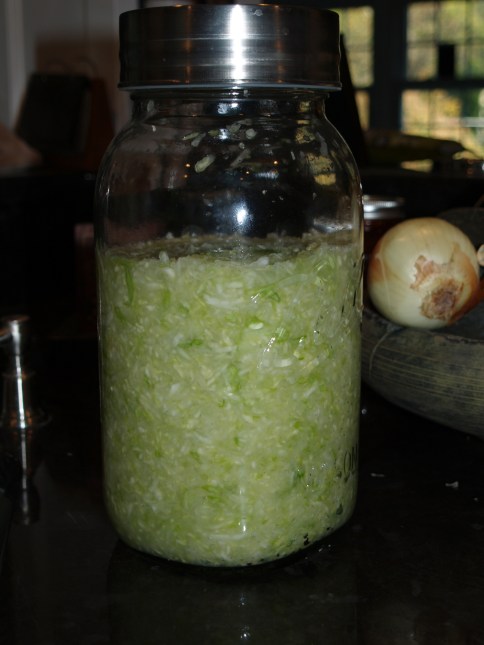
 

Sauerkraut on the Ferment


The sauerkraut will develop at a rate directly correlated with temperature.  At 45 Fahrenheit, fermentation is very slow, at 90 Fahrenheit it is notably faster.  Lower temperatures, in the 70 Fahrenheit range make a superior kraut.

After 3-5 days, give the sauerkraut a taste.

See if it suits you.  Some people love the flavor of an immature green kraut.  If it’s not the flavor profile you want, let it sit longer for the flavors to develop.  Once it is to your liking, place in smaller jars and move to the refrigerator or other cool spot (like a root cellar).  The slows down the fermentation process.

Taste-testing the developing sauerkraut has become my daughters job and her taste buds are definitely evolving.  We currently have a jar of sauerkraut that has been on the counter for three weeks.  We are using it, but she has not asked to have it moved the fridge.  Surprisingly it has not gotten very very sour, just more delicious.

There are many ways to enjoy your kraut, most recently we had ours atop BLT’s served on a great sourdough made during the big snow storm.
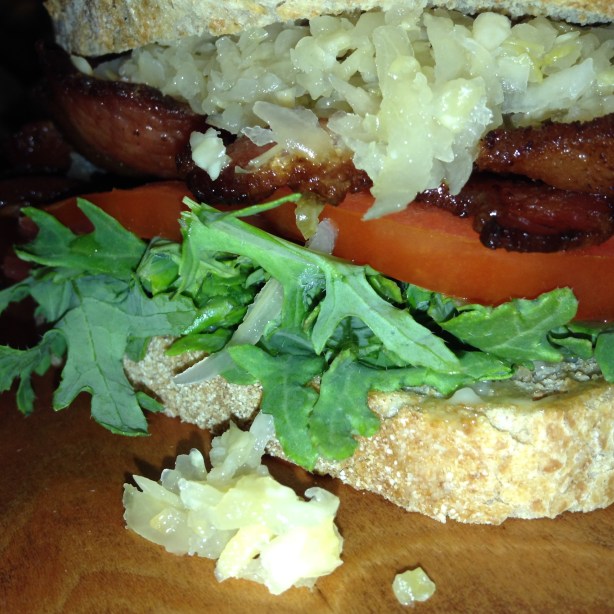
sourdough BLT with sauerkraut

sourdough BLT with sauerkraut


Sources:

Katz, Sandor Ellix. The Art of Fermentation: An In-Depth Exploration of Essential Concepts and Processes From Around the World.  White River Junction, VT: Chelsea Green Pub., 2012. Print.

“What Are The Benefits Of Sauerkraut Juice?”. Livestrong.Com

Ten Reasons to Eat Fresh Unpasteurized Sauerkraut | Vitality Magazine | Toronto Canada alternative health, natural medicine and green living


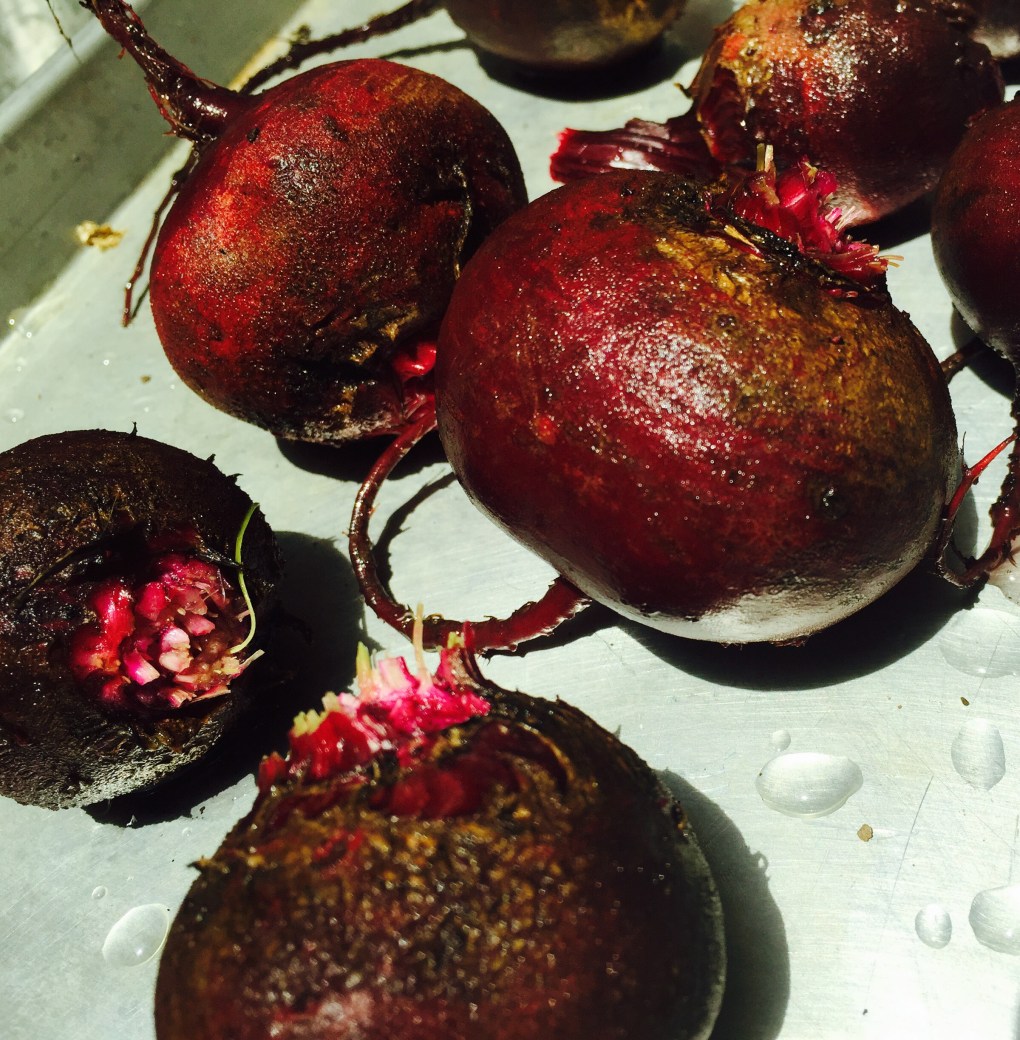
winter ferments – gingered beet and carrot slaw

The dinner table in a monastery is always set with care for both daily fare and feast days. Food is arranged to show the full beauty of God’s harvest in vegetables, grains, dairy products, and fruit.

Victor-Antoine d’Avila-Latourrette

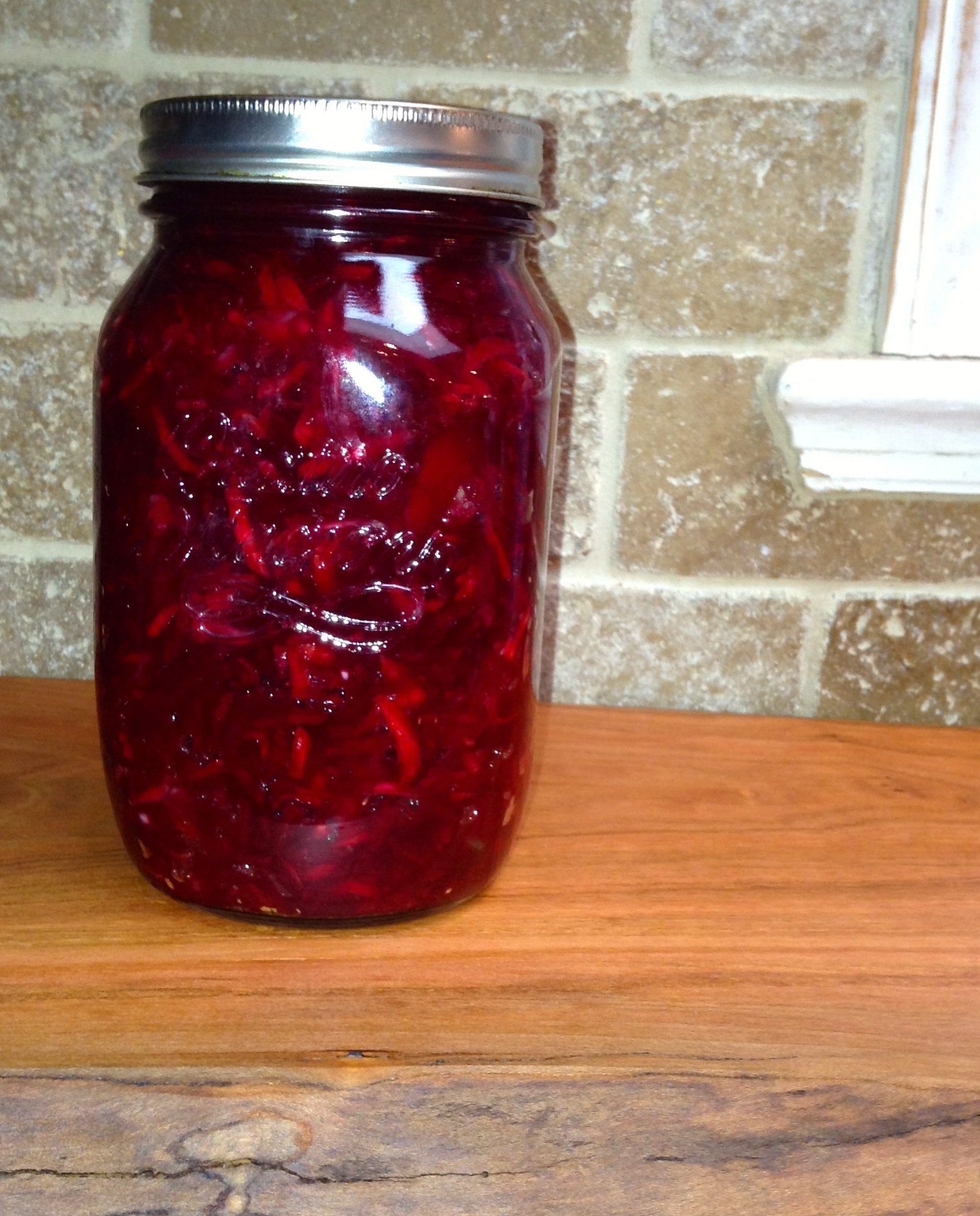
Oh…!  The rich earthy flavor of this slaw just get better over time.  If you are a fan of beets, this does not disappoint – not one bit!  Fermenting is a low-cost, efficient and easy process that preserves foods – some indefinitely!  We still have the remnants of a corn jalapeño salsa ~ from two years ago ~ that is still viable, delicious and enjoyed!

Ferments have a self sufficient versatility – but at the same time, pair well with a variety of dishes.  Fermenting your own vegetables is an artisanal delight that is flavorful, healthy and when made with your local harvest good for the planet too!


Gingered Beet and Carrot Slaw

When fermenting –  use the best quality ingredients available to you.  Remember, local, simple and seasonal freshness make all the difference in and to the world!

ingredients:

300 grams fresh shredded carrots

500-600 grams fresh shredded beets

100 -200  grams onions (optional)

1/2 – 1 teaspoon shredded fresh ginger

2 teaspoons salt

fermenting ingredients

preparation:

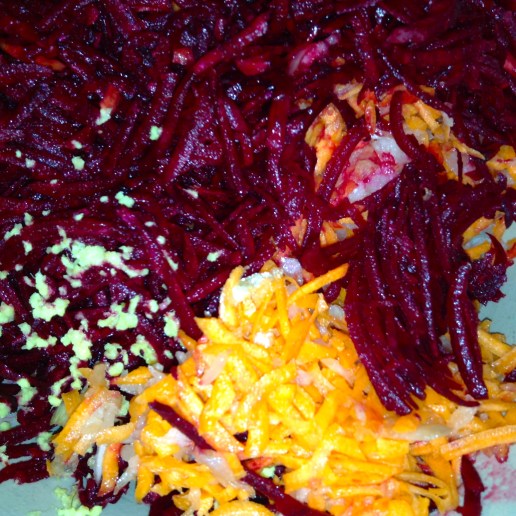
Wash hands.  Place all ingredients in large clean bowl.  Mix and massage the mixture with hands, squeezing to extract the natural juices.  Some recipes call for a brine to be added to the slaw, but my experience (and preference) is that my local fresh ingredients produce enough liquid when the salt is added to cover the vegetables.  This is the same principle used for sauerkraut.

IMG_0238

Mix for about 10 minutes (this is a great work out!).  Place in a clean mason jar and leave out of direct sunlight.

After about 5 days taste and continue to do this every day until the taste you desire is achieved.


 Fermented Beet Carrot and Ginger Slaw


seasonal eating

seasonal eating

It is a struggle in a prepackaged world with jets and ocean liners bringing everything we can possibly desire from the four corners of the globe right into our little community.  Whereas the local harvest is selected at the peak of ripeness, it’s conventional counterparts are picked well before maturity and prior to maximal development of nutrition and flavor.

Calorie per calorie seasonal local produce outmatches its conventional cousins in nutrient density – and that’s just for starters.  This nutrient density is essential for vibrant optimal health.

Seasonal eating is a subtle ~  and to be honest – difficult at times – asceticism yielding patience.  The satisfaction of what nourishes us presently, along with the patience of the anticipation of the delicious nourishing foods of the next season…It is the patience that a connectedness to our landscape fosters.  At the moment our table is laden with lots of squashes, broccoli, cabbages, cauliflower and beets.

Despite cool weather, winter gardens can yield a bounty!!   They are also a traditional way to add sustainability and some distance from the industrial food chain into ones diet!

Plotting a little Victory Garden in your back yard is easier than you might think!

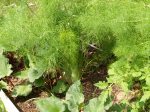
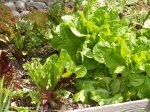
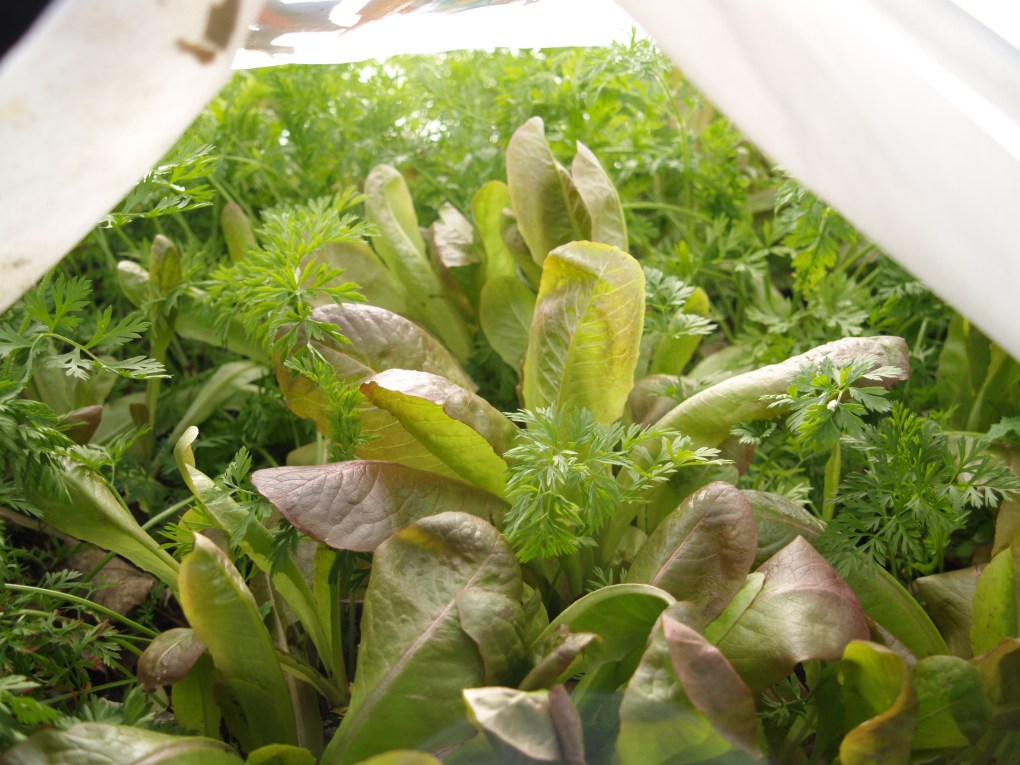
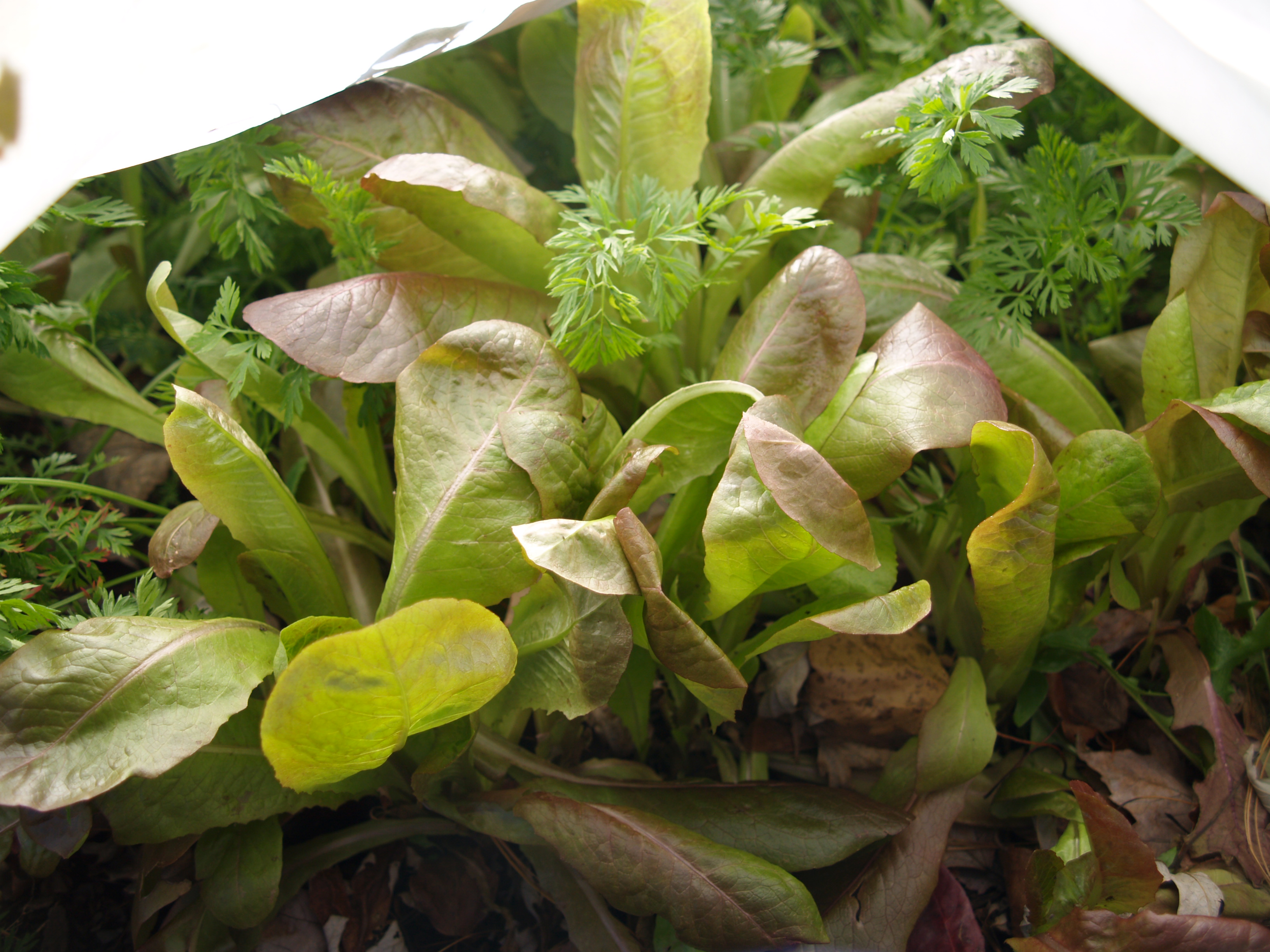
Although it is January in Virginia, there are kale, lettuces, carrots and fennel growing quite nicely in this Victory garden!  Not quite enough to feed the entire family, but a great supplement to our meals!

victory garden – under cover – winter carrots and lettuces

victory garden – under cover – winter carrots and lettuces

Our eggs, meat and dairy are local, all within 300 miles of home.  With the help of a little Victory Garden, local Winter CSA’s and our community market, enjoying the bounty of our local food shed despite winters chill, is a reality.

Depending where you live, winter is likely a time of scarcity.  When unable to find food from your own state, try to stay as close to your own geography as possible.  Our first choice is from our tri-state area, and we venture out from there, trying to stick with the eastern seaboard.  That said, if we want oranges, we chose those grown in Florida rather than California.

Once we tire of our winter vegetables which are remarkably sweet if you can rustle them up locally, the harvest will be over, and we will again begin to savor the first spring vegetables – which cleanse the body and coincide with the beginnings of Great Lent ~ which cleanses the body and the soul.

Whole foods and seasonal eating ~ good for the local farmers, our pastoral responsibilities to our land and the nourishment of our bodies…

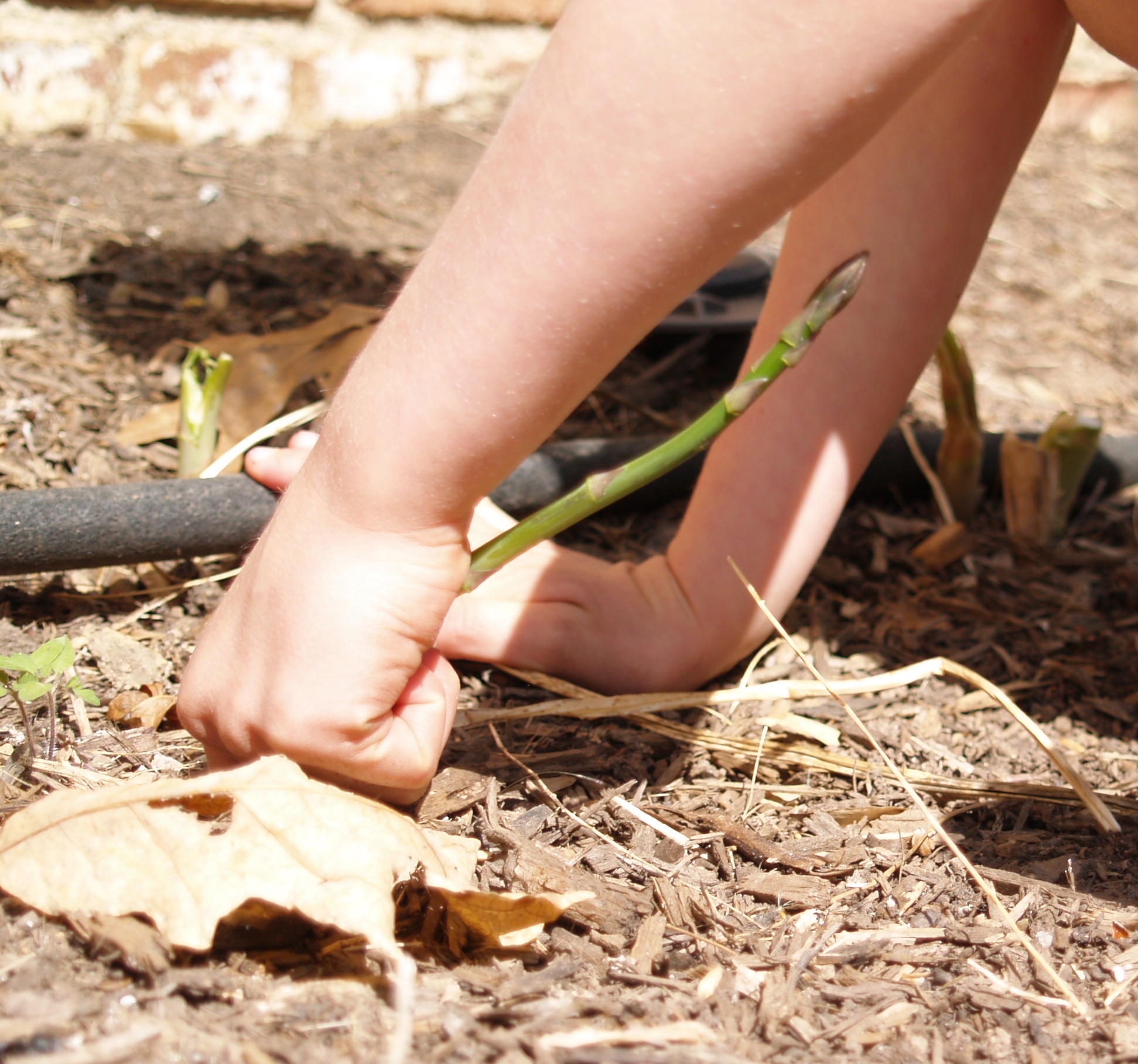
tiny hands with an asparagus snack

tiny hands with an asparagus snack


reprinted – originally posted January 2013


edible-fall

seasonal eating ~ edible-fall

Today there is a resurgence of folks trying to eat within the boundaries of their local geography and with good reason : local, seasonal food, prepared and eaten properly supports vibrant health and energy and is sustainable for the earth.  The thing is, it’s easier to accomplish during the long warm days of summer – when the harvest is plentiful and bringing it to the table is as simple as a trip to the farmer’s market, local market or your own backyard.

Seasonal cooking takes effort but with an adventuresome palette – a willingness to experiment – you can make your meals a seasonal thanksgiving of your landscapes harvest.  It’s simpler than you might think!
In our area of the mid-atlantic, the early days of September have already begun to melt away the lingering rays of a hot and lazy summer.  The fresh morning chill settles in overnight heralding the first days of autumn.  Waxing and waning…. it all blends together, these seasonal changes.  Those last warm days of summer are actually the first cool days of autumn. and with that our Indian Summer ushers in a whole new variety of possibilities at the farmers market.
Garner's Produce 2013


In these past few weeks, hearty fall vegetables have made their annual debut, and their rich unpretentious earthy colors are a prelude to same colorful beauty our eastern forests display in their show of fall leaves –  just before they shed to adorn the forest floor.

Foods in your local season, tend to support your wellness in that season.  Fall foods are warming foods.  Produce that matures in cooler months generally contain more calories than their summer counter-parts, and come with their own complement of nutrients.  By helping our bodies acclimate to our regional weather, they perpetuate our health and may help prevent frequent seasonal ailments.

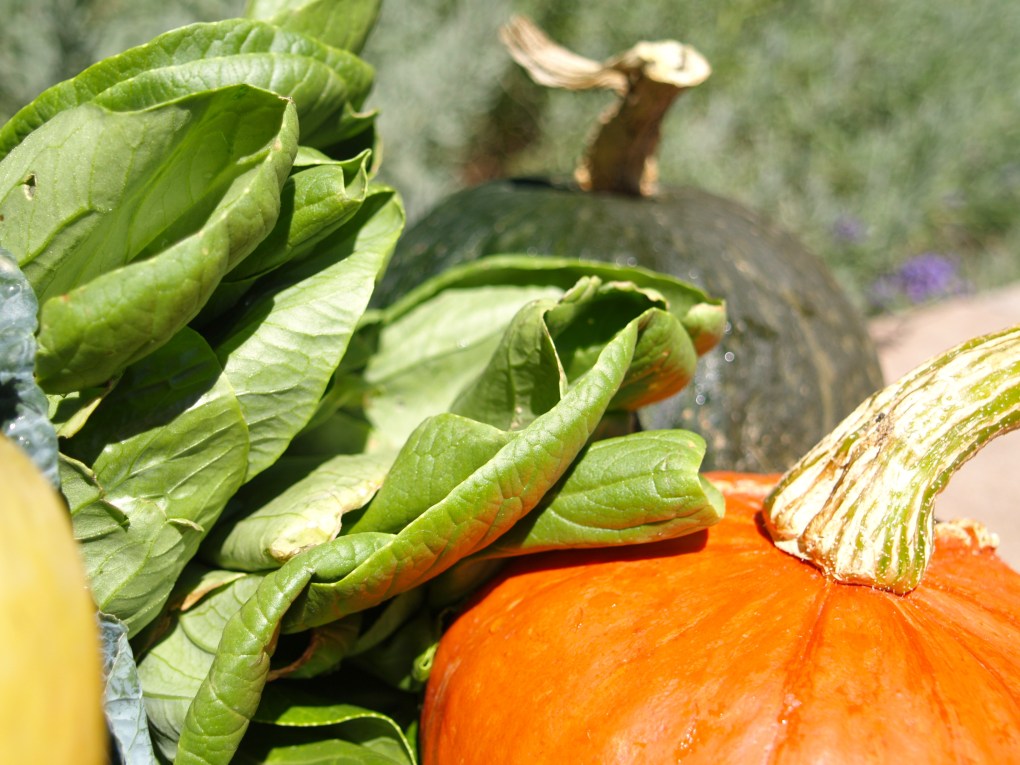
So here they are, the first butternut squashes, oddly colored and shaped gourds, beets and of course – the fall favorite – pumpkins,  all emerging at the farmer’s market.

first fall 2013 squashes and gourds - Garners Produce

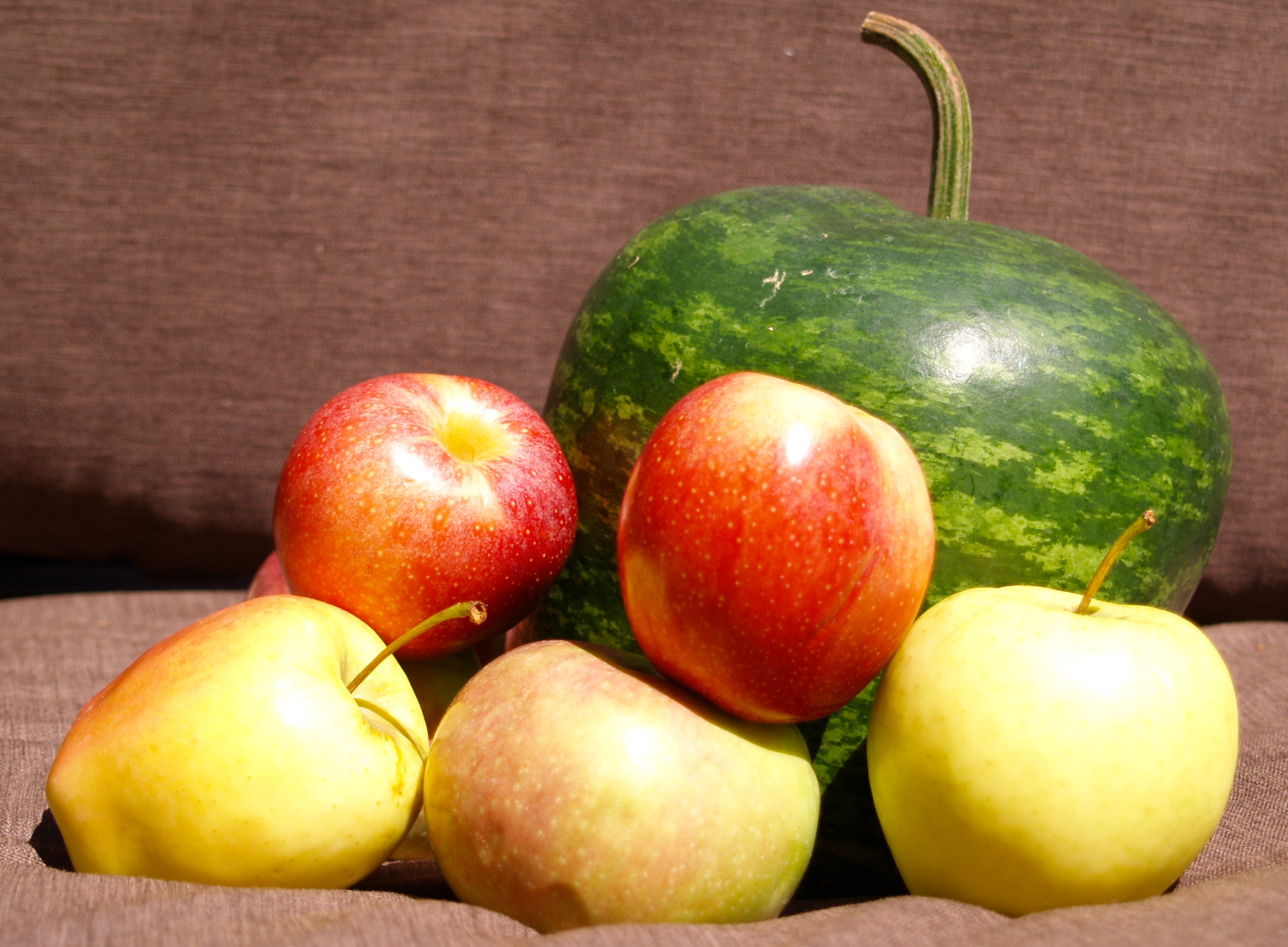
Virginia and West Virgnia is apple country, and those too are sure not to disappoint – especially not the heirloom varieties that farmers are lovingly resurrecting for locals hungry for real food!


fall 2013 Virginia apples - except for the really big one which is an apple gourd...

fall 2013 Virginia apples – except for the really big one which is an apple gourd…


As the weather changes, so to does our pantry… and a well-stocked pantry is the only way we’ve found to cook with ease at home.  Posts in the upcoming weeks will include stocking our fall pantries with a few basics, to make this seasons cooking simple and easy.

Our favorite food of the season is soup… the backbone of which is broth and that simple humble and nourishing broth is the perfect canvas to highlight so many of the glorious foods of autumn.  And that is the feature future posts – broth and soups and stews!