The 15th Antiphon is sung in every single Orthodox Church the world round on Great and Holy Friday,…. and it is the chant lament of all eternity. That night we read the twelve Gospels of His passion. We lament Christ’s Crucifixion – along with all of creation – with every blade of grass, the rocks and with the very rays of the sun which hide in mourning.
Yet if you listen to the hymn – you’ll find in the midst of the darkness of the worlds groaning eison lies an undergirding of the glorious hope of the Gladsome light of Christ’s Resurrection.
It is a hymn that finds its expression most beautifully in a byzantine setting. So, no matter where we worship, it is this very hymn that we always listen to on the way home from Church.
May we together have enough oil in the vessels of our souls, so that, not wasting the time of rewards in buying more, we may sing, “Bless the Lord, O works of the Lord.”
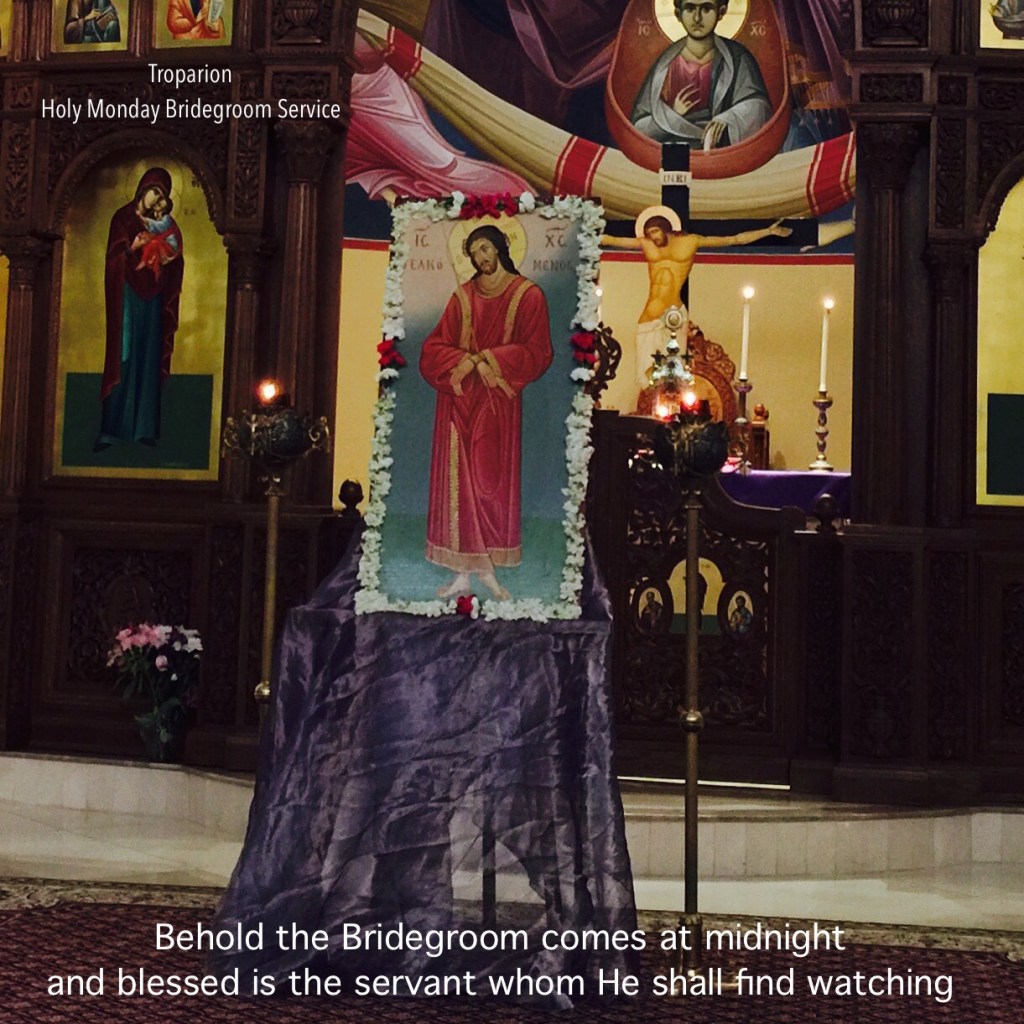
Holy Monday Bridegroom Service
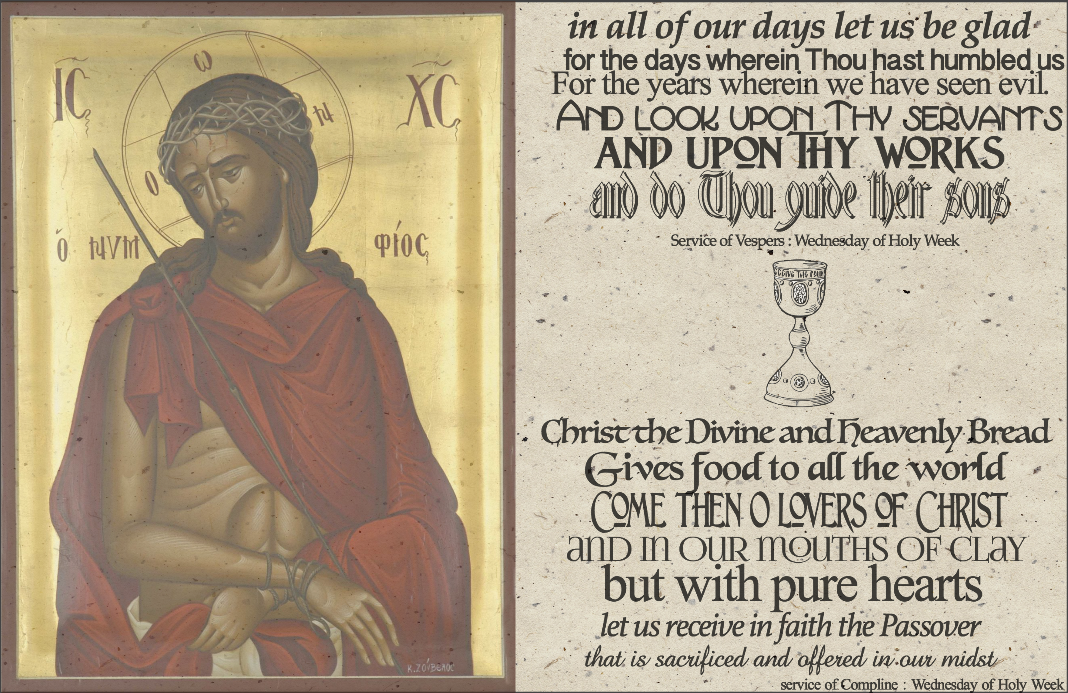
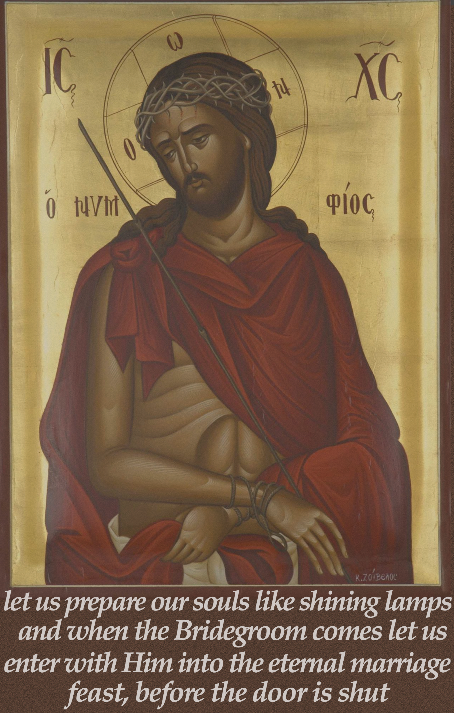
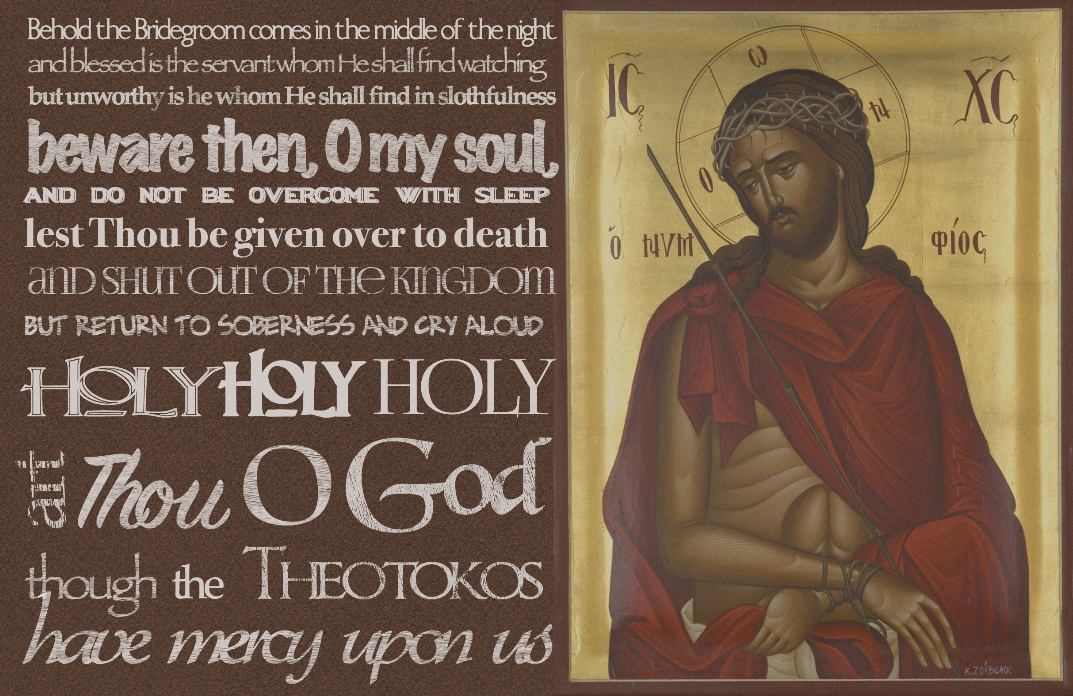
Next week is Holy Week for Orthodox Christians. During the first three days of Holy Week – beginning with Monday (Sunday_, we hear one of the most solemn sober mystical moving and beautiful hymns of the Church year…. “Behold the Bridegroom comes at midnight and blessed is the servant whom He shall find watching“. It is a hymn based on the parable of the wise virgins in Matthew 25:1-13. Our Mother the Church always draws our hearts and minds to the timeless steadfast wisdom truth of what is needful. Monastics always remind us that to live in the present moment and to live in remembrance of our death is a great gift… not a sorrowful morose outlook, but rather a sober yet joy filled Heavenly Kingdom centered focus.
According to the Orthodox Study Bible, the parable of the wise virgins is about the virtue of preparedness and charity and almsgiving. It is also about the Second Coming, and “the impossibility of changing one’s state of virtue after death” (Orthodox Study Bible Footnotes). Being watchful and ready. Behold the Bridegroom comes in the middle of the night, and blessed is the servant whom He shall find watching.
The wise virgins are those who practice charity and mercy in this life, while the foolish are those who squander God’s gifts on themselves…
Footnotes: Orthodox Study BIble
The oil of our lamps is the oil of Faith and the vessel of the lamp is our very soul. It is the oil of faith, of virtue, of gladness, of mercy, of forgiveness, of love, of repentance of prayer and thanksgiving – devotion to God the Father through Christ and the Holy Spirit. Holy fuel… ever lighting the wicks of the hearts of Orthodox Christians – the Paschal flame dispelling darkness. “Come receive the Light that is never overtaken by night... ” like the Paschal candle, Christians are called to walk in the world not of the world, with the Paschal flame not hidden under a lamp but visible and touchable – like the Paschal candles we soon light and spread illumining and spreading through our Churches – we are not saved alone, because we are the members of the Body of Christ.
Come glorify Christ Who is risen from the dead!” As we walk the arduous coming journey with Christ through Holy Week,waving palm crosses and singing Hosanna in the Highest at His humble Entry into Jerusalem; pouring fragrant mhyrr upon him and kissing His soon to be bruised feet, sitting with Him at His “take eat this is my body and blood which is shed for you and for many for the remission of sins” Last Supper; the betrayal of one who did not repent, His passion, beating and bent crown of thorns placed upon His head scourging; His voluntary death on the Cross, to His glorious “death trampling down death” Resurrection. May our walk be Lenten and blessed. May we be lentenly blessed and rejoice in His glorious resurrection. Kalo Pascha. Καλό Πάσχα! Blessed Pascha.
May we together have enough oil in the vessels of our souls,
so that, not wasting the time of rewards in buying more, we may sing:
“Bless the Lord, O works of the Lord!”
On Great Friday, we observe the Holy, saving and awesome Passion of our Lord, and God, and Savior Jesus Christ;
the spittings, the scourgings, the buffetings, the scorn, the mocking, the purple robe, the reed, the sponge, the vinegar, the nails, the spear and above all, the Cross and death, which He willingly suffered for us.
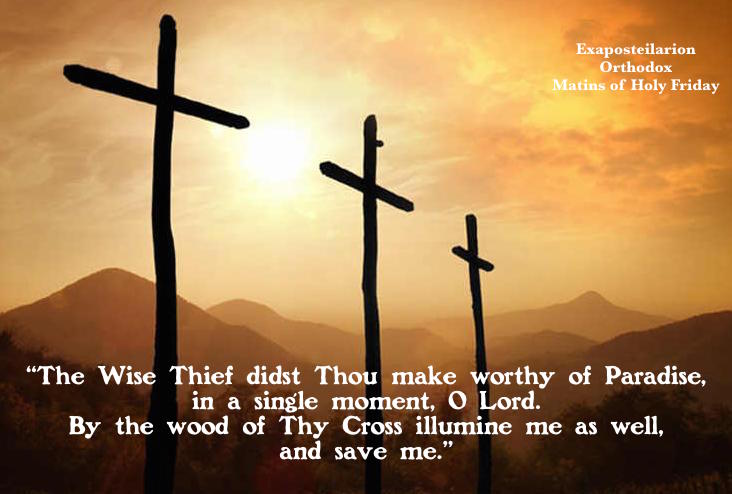
We also observe the confession unto salvation of the penitent thief, who was crucified with Him.
from the Synaxarrion of Great Friday
the 15th Antiphon is chanted in all Orthodox Churches on Thursday evening.
Christ is the ultimate fulfillment of Pascha. He performed the ultimate passage : from death into life, from this “old world” into the new world and new time of the Kingdom. And He opened the possibility of this passage to us. Living in “this world,” we can already be “not of this world”.
Here and now, we can be free from slavery to death and sin, and partakers of the world to come. But for this we must perform our own passage. We must condemn the old Adam in us. We must put on Christ in the baptismal death and have our true life hidden in God with Christ in the “world to come”.
Thus Easter is not an annual commemoration – solemn and beautiful – of a past event. It is this Event itself, shown and given to us, as always efficient, always revealing our world, our time, our life as being at their End and announcing the Beginning of the new life.
The first three days of Holy Week challenges us with this ultimate meaning of Pascha and to prepare us to understand and accept it.
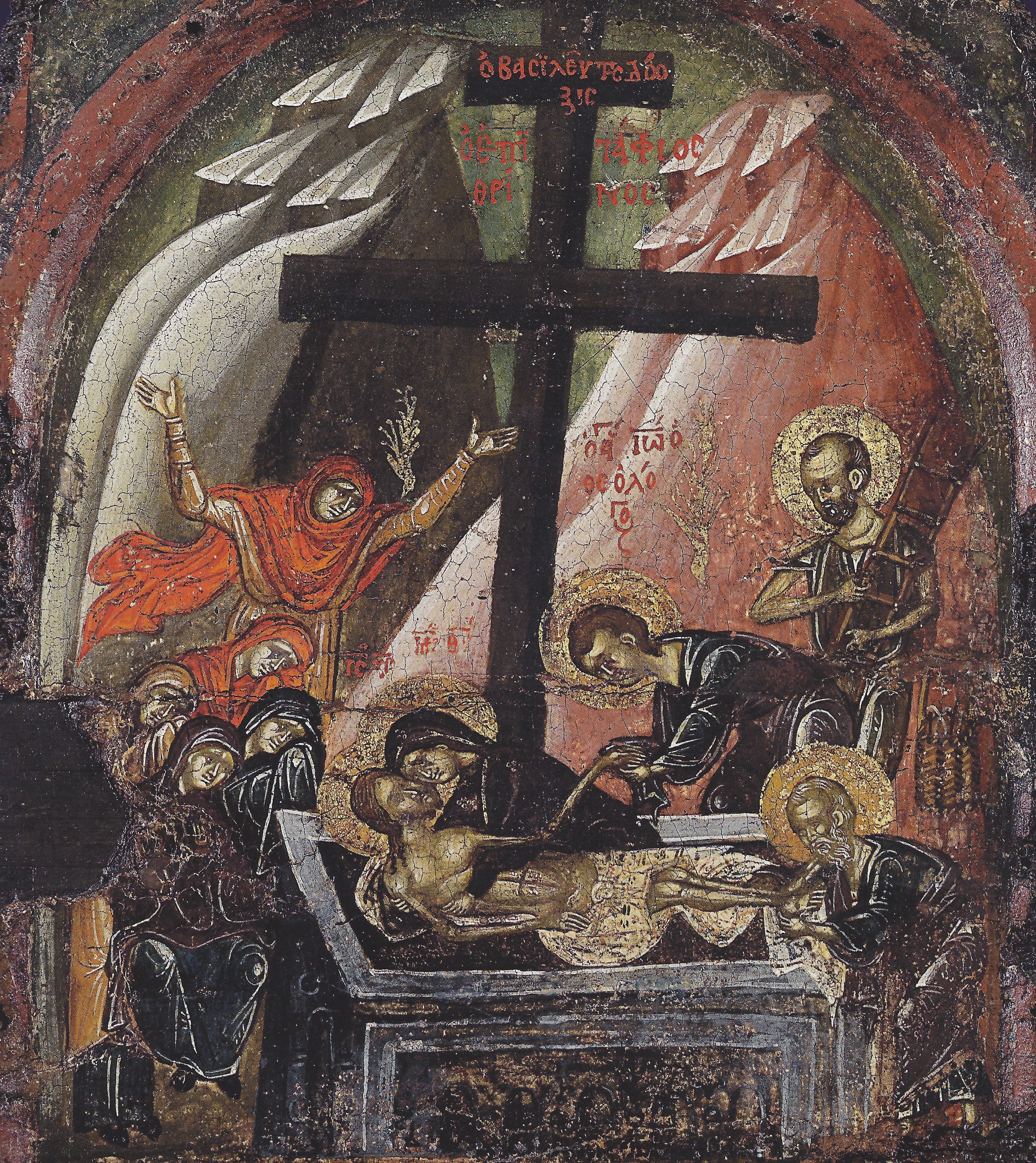
And together with Joseph and Nicodemus we will beg for His body,
wrap Him in fine linen and place Him in a new tomb.
We will come hand in hand with the myrrbearers to anoint His body and find it is gone.
And on Pascha we will behold the awesome glory of His Resurrection
Great Lent is over and the faithful have emerged
– prepared for this journey through the mystery of Holy Week-
earthly cares and senseless hollow triflings aside
because even during this arduous . solemn . heart-wrenching . brutal yet hopeful path to Golgotha
His burden is easy and His yoke is light
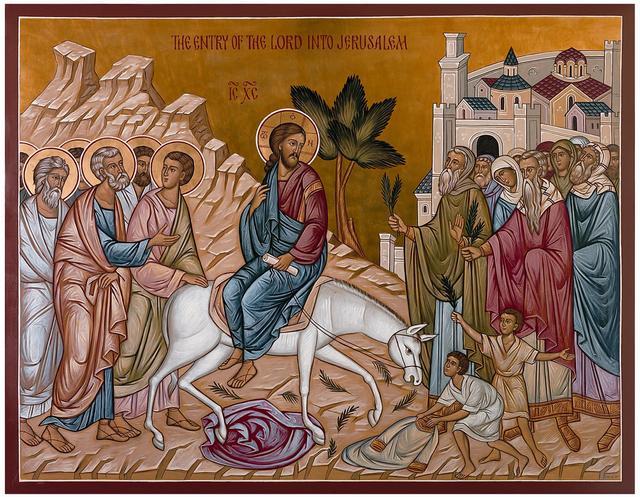
This is Palm Sunday, and today the faithful – filled with the hope of the Resurrection –
join with the angels & children, singing a song of victory
glory to God
Hosanna in the highest
blessed is He that comes in the name of the Lord!
“Palm Sunday is ‘the end of an entire process of preparation, as revealed in the Bible. It was the end of all that God did for us, and thus this short hour of Christ’s earthly triumph acquires an eternal meaning.
It introduces the reality of the Kingdom into our time, into all hours, and makes this Kingdom the meaning of time and it’s ultimate goal. The Kingdom was revealed in this world and from that hour. It’s presence judges and transforms history…
On Palm Sunday, this reality is our own involvement in and our responsibility to the Kingdom of God… And He does not need any “symbols” for He did not die on the Cross that we may eternally “symbolize” His life…If we are not ready to stand by the solemn oath which we renew every year on Palm Sunday, if we do not mean to make the Kingdom of God the measure of our whole life – then meaningless is our commemoration and vain are the branches we take home from Church.’ “
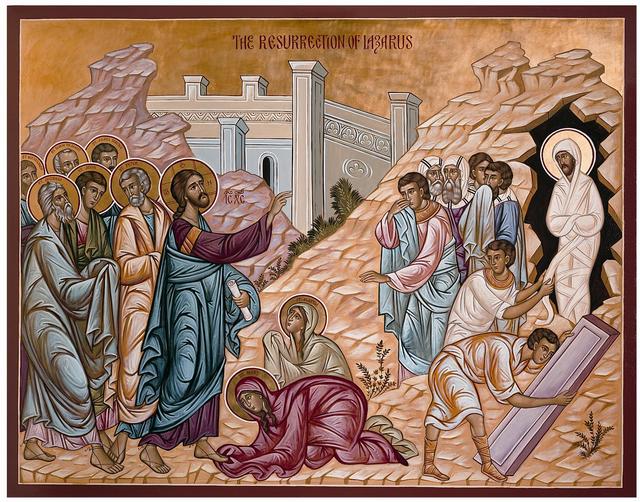
“We understand that it is because He wept, because He loved His friend Lazarus that Jesus had the power of calling him back to life. The power of resurrection is not a divine “power in itself”, but the power of love – or rather love as power.
God is Love and Love is Life.
Love creates Life.
It is Love that weeps at the grave and it is Love that restores life.
This is the meaning of the divine tears of Jesus. In them love is at work again – recreating, redeeming, restoring the life of man: Lazarus! Come forth!”

 gladsomelife.com