The 15th Antiphon is sung in every single Orthodox Church the world round on Great and Holy Friday,…. and it is the chant lament of all eternity. That night we read the twelve Gospels of His passion. We lament Christ’s Crucifixion – along with all of creation – with every blade of grass, the rocks and with the very rays of the sun which hide in mourning.
Yet if you listen to the hymn – you’ll find in the midst of the darkness of the worlds groaning eison lies an undergirding of the glorious hope of the Gladsome light of Christ’s Resurrection.
It is a hymn that finds its expression most beautifully in a byzantine setting. So, no matter where we worship, it is this very hymn that we always listen to on the way home from Church.
One example of God stooping down to our level is given to us in the Psalms. Do you remember the wonderful image of Christ stooping down in order to drink from a running stream? He shall drink of the brook in the way, it says, therefore shall He lift up His head. (Psalm 109.7). What does this mean? That “although you forget me, I, the heavenly God, stoop down just as you do. I share in your life, so that you can share in Mine. I move and act like you do to show you that I’ve become like you, so that you can become like Me.
Do you grow weary on your journey? So do I. (John 4.6) Do you thirst? (John 4.7, 19, 28) So do I. Do you stoop down to drink water? I do the same. I humble Myself. I empty Myself. (Phil 2.7). I drink and refresh Myself. What more can I do? What do you do that I don’t?
And since I am so close to you stooping down alongside of you, can’t you catch hold of Me?
It would be a mistake to think of the sacrifices of Lent in purely negative terms—in terms of struggle and deprivation. We are to think of Lent as liberation. Lent calls us to sacrifice many of those things which, while they tend to occupy such a central position in our lives, while they seem to us to be so important, are in reality things we can do without. Lent is thus the rediscovery of that which is most essential in our lives. In this rediscovery, we return to God and to the very meaning of life. Thus, having stripped ourselves of all that is petty and futile, having cast off the burdensome baggage of our worldly and often complex lifestyles, we can truly experience Lent as liberation and purification, as the necessary, fruitful, and wonderful journey to the joy of Pascha.
“We must always pray. But Lent is the time of an increase of prayer and also of its deepening. The simplest way is, first, to add the Lenten prayer of St. Ephrem the Syrian to our private morning and evening prayers. Then, it is good and profitable to set certain hours of the day for a short prayer: this can be done “internally”—at the office, in the car, everywhere. The important thing here is to remember constantly that we are in Lent, to be spiritually “referred” to its final goal: renewal, penitence, closer contact with God.”
Father Alexander Schmemman
Lord and Master of my life, take from me the spirit of sloth, despair, lust of power, and idle talk
But give rather the spirit of chastity, humility, patience, and love to Thy servant.
Yea, O Lord and King, grant me to see my own transgressions, and not to judge my brother, for blessed art Thou, unto ages of ages. Amen.
The life of the faithful should be filled with joy and gladness, which are among the fruits of the Holy Spirit. The Holy Spirit Himself gives these fruits both to our souls and to our community. At the same time, our life must be something that transcends the world, informed by theological thought and feeling, manifesting the experience of eternity the place and time in which we live. We are obliged truly to be people of eternity….
We are obliged to learn, to think, and to live, to rejoice and to weep, to experience God, and to be raised to the heavens, exactly as did the Saints of the Church. This follows from the unity of the Church, which is something that God grants to us when we gather together.
Prayer then, since it is communion with God, is gladdening. Certainly we shall have our struggle against our sins, and our passions. But not even this should depress us, once we have put our life into Jesus Christ’s hands. The struggle is necessary, however, for our life to be blessed.
“You must run after the Prayer (the “Prayer” is the Jesus Prayer). To have the Prayer you must continually pray inside. Run after the Prayer, do not be talking rather only be praying.”
blessed Geronitssa Makrina
+ + +
“When saying the Jesus Prayer keep your mind empty; with the Jesus Prayer your mind will be clean and full of light. You will see your every fault. With the Jesus Prayer you will always say it is my fault NOT someone else’s fault.”
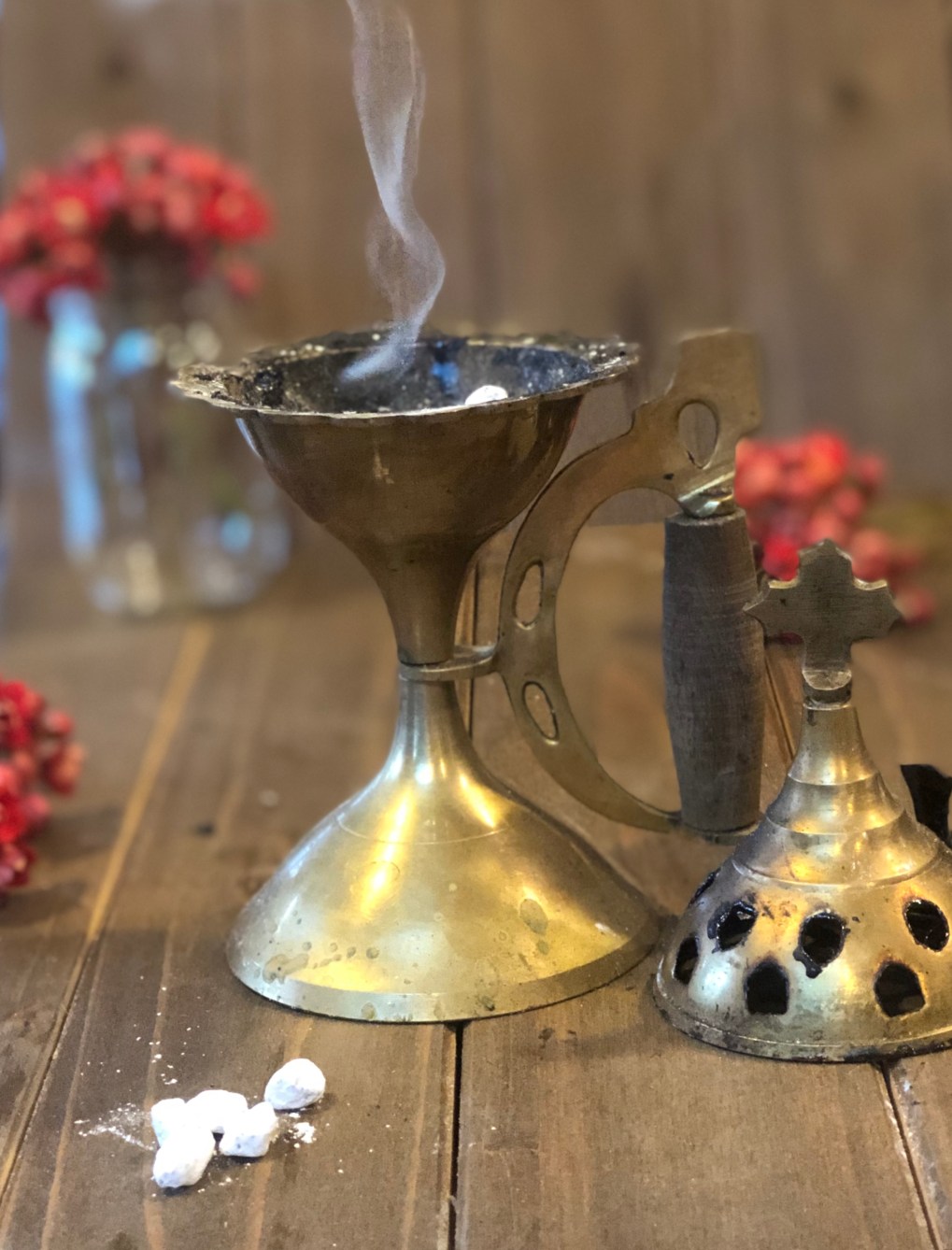
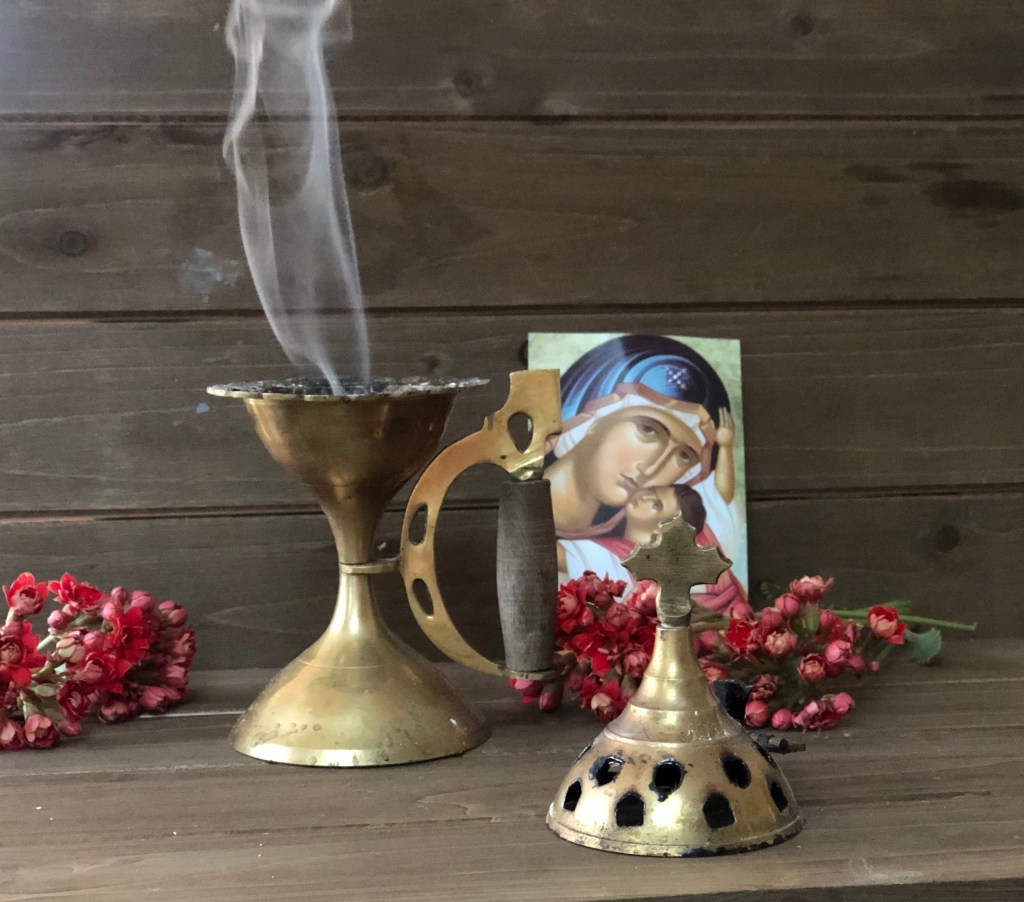
That censer of ours, it is probably twenty some years old. It has a well worn oft used sweet smelling incense patina on the inside and a “let my prayer arise as incense” luster on the outside. Recently – in the past year – it has become unhinged. Not pictured is the candle wax dripped scribbled names in the margin and some crayon markings from the kids Jordanville prayer book which also has pages falling out. So many times I have come so close to purchasing a shiny new brass or nickel censer and crisped white no writing on the pages brand new unbroken spine prayer book but then I always put them down.
Unlike the pages falling out of the prayer book, no page of prayer falls out of the book of God’s heart. The censer : a visual reminder that prayer is oft born of the unhinged censer of a broken and contrite heart… it is such a prayer that arises as incense, a prayer that God knows before even it is spoken and one that God will not despise.
The Grace of God, that comes with the sweetest name of Jesus, softens the soul. The world could be upside down, and inside a person there is meekness, self control, peace and a spiritual state of great delight.
The compassion of God is like the ocean, like the heavens. God does not say, “why did you sin?” but instead, “why didn’t you get up?” He forgives us for everything: it is enough that we repent as soon as we understand we have made a mistake. Are we not human? We fall. However, we must get up. Christ loves us so much!”
O Word supreme in love, who with the Father and the Spirit hast created all things visible and invisible in Thy wisdom past speech, grant that we may spend the season of the joyful Fast in profound peace.
Matins: Tuesday in Cheesefare Week
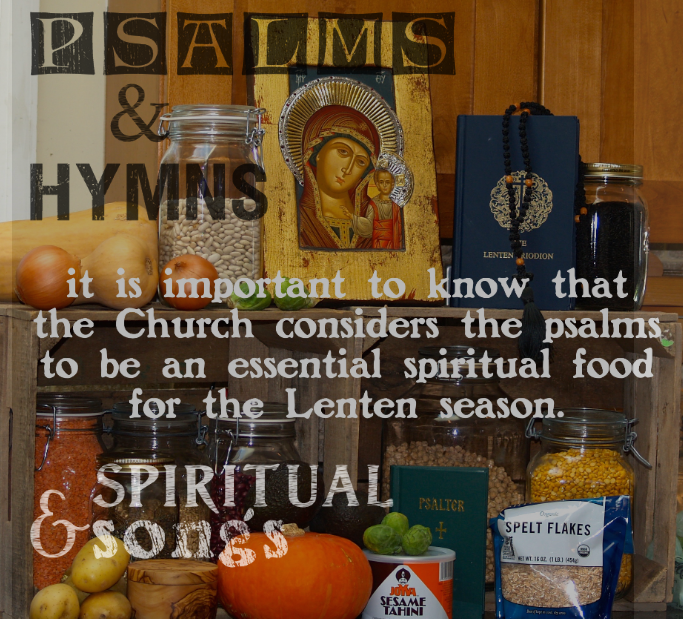
This past week of Meatfare and this present week of Cheesefare offers Orthodox Christians a wonderful occasion to clean our pantries of leftover meat, dairy and eggs as we ease into the strictness of the Fast – when, through the effort of Lent, we also clean the pantry of our hearts. During the forty day fast we forgo heavy and clogging meals, seeking instead our nourishment from lighter and more cleansing plant-based sustenance. All of this fasting fare is, of course, fortified with the Lenten services and soul-restorative calories found as the faithful graze within the beautiful spiritual pastures Lent.
Throughout these past weeks, our Mother the Church, has shepherded, taught and nudged the faithful closer and closer to the bounds of the Great Lent. It is through these weeks of preparation that the aspiration of this Great Fast has been made clear once again – that it is not the rigidity of dietary restrictions (to which we are certainly called to adhere), but rather the grace of an inner change of heart.
Genuine fasting has as an essential ingredient the relationships of family and community. Isn’t it pleasant when brothers dwell in unity… we are not saved alone. A wise retired priest told me once that being in family and community can be likened to a satchel of sharp jagged rocks. Through the jostling of life we rub each other, sometimes the wrong way, with our sharp edges. Friction happens – but through time and forgiveness, those rocky edges become smooth and mellowed. Forgiveness Vespers seeks to erode those jagged edges of relationship.
And so it is, that this Sunday, the Orthodox Christian Lenten journey is ushered in with love and forgiveness.
How appropriate that the first flavor of this awesome labor of fasting is found in a feast… the blessed taste of forgiveness – that given and received – during the Vespers of Forgiveness this very weekend. These past weeks of the humility of the Publican, the faithful perseverance of the woman at the well, the coming to his senses of the Prodigal – a return to the Father – these intend to soften hearts.
Great Lent is a walk of joy, an annual journey of the faithful body of Christ.
Does it really come as any great surprise that the faithful rejoice in this Fast with gladness? For truly, to savor even a crumb off of Lenten tables laden with fasting, reminds us that we are blessed, we are blessed, we are so very richly blessed!








 gladsomelife.com