it is a liberation

It would be a mistake to think of the sacrifices of Lent in purely negative terms—in terms of struggle and deprivation. We are to think of Lent as liberation. Lent calls us to sacrifice many of those things which, while they tend to occupy such a central position in our lives, while they seem to us to be so important, are in reality things we can do without. Lent is thus the rediscovery of that which is most essential in our lives. In this rediscovery, we return to God and to the very meaning of life. Thus, having stripped ourselves of all that is petty and futile, having cast off the burdensome baggage of our worldly and often complex lifestyles, we can truly experience Lent as liberation and purification, as the necessary, fruitful, and wonderful journey to the joy of Pascha.

Father Alexander Schmemman


lord and master of my life

“We must always pray. But Lent is the time of an increase of prayer and also of its deepening. The simplest way is, first, to add the Lenten prayer of St. Ephrem the Syrian to our private morning and evening prayers. Then, it is good and profitable to set certain hours of the day for a short prayer: this can be done “internally”—at the office, in the car, everywhere. The important thing here is to remember constantly that we are in Lent, to be spiritually “referred” to its final goal: renewal, penitence, closer contact with God.”

Father Alexander Schmemman

Lord and Master of my life, take from me the spirit of sloth, despair, lust of power, and idle talk

But give rather the spirit of chastity, humility, patience, and love to Thy servant

Yea, O Lord and King, grant me to see my own transgressions, and not to judge my brother, for blessed art Thou, unto ages of ages. Amen.


on spiritual reading

We cannot be in church daily, but it is still possible for us to follow the Church’s progress in Lent by reading those lessons and books which the Church reads in her worship. A chapter of the Book of Genesis, some passages from Proverbs and Isaiah do not take much time, and yet they help us in understanding the spirit of Lent and its various dimensions. It is also good to read a few Psalms—in connection with prayer or separately. Nowhere else can we find such concentration of true repentance, of thirst for communion with God, of desire to permeate the whole of life with religion. Finally, a religious book: Lives of the Saints, History of the Church, Orthodox Spirituality, etc. is a “must” while we are in Lent. It takes us from our daily life to a higher level of interests, it feeds us with ideas and facts which are usually absent from our “practical” and “efficient” world.

Father Alexander Schmemann


you are what you eat

In the Bible the food that man eats, the world of which he must partake in order to live, is given to him by God, and it is given as communion with God.  The world as man’s food is not something “material” and limited to material functions, thus different from, and opposed to, the specifically “spiritual” functions by which man is related to God.  All that exists is God’s gift to man, and it all exists to make God known to man, to make man’s life communion with God.

It is divine love made food, made life for man.

God blesses everything He creates, and, in biblical language, this means that He makes all creation the sign and means of His presence and wisdom, love and revelation:

“O taste and see that the Lord is good.”

Father Alexander Schmemann


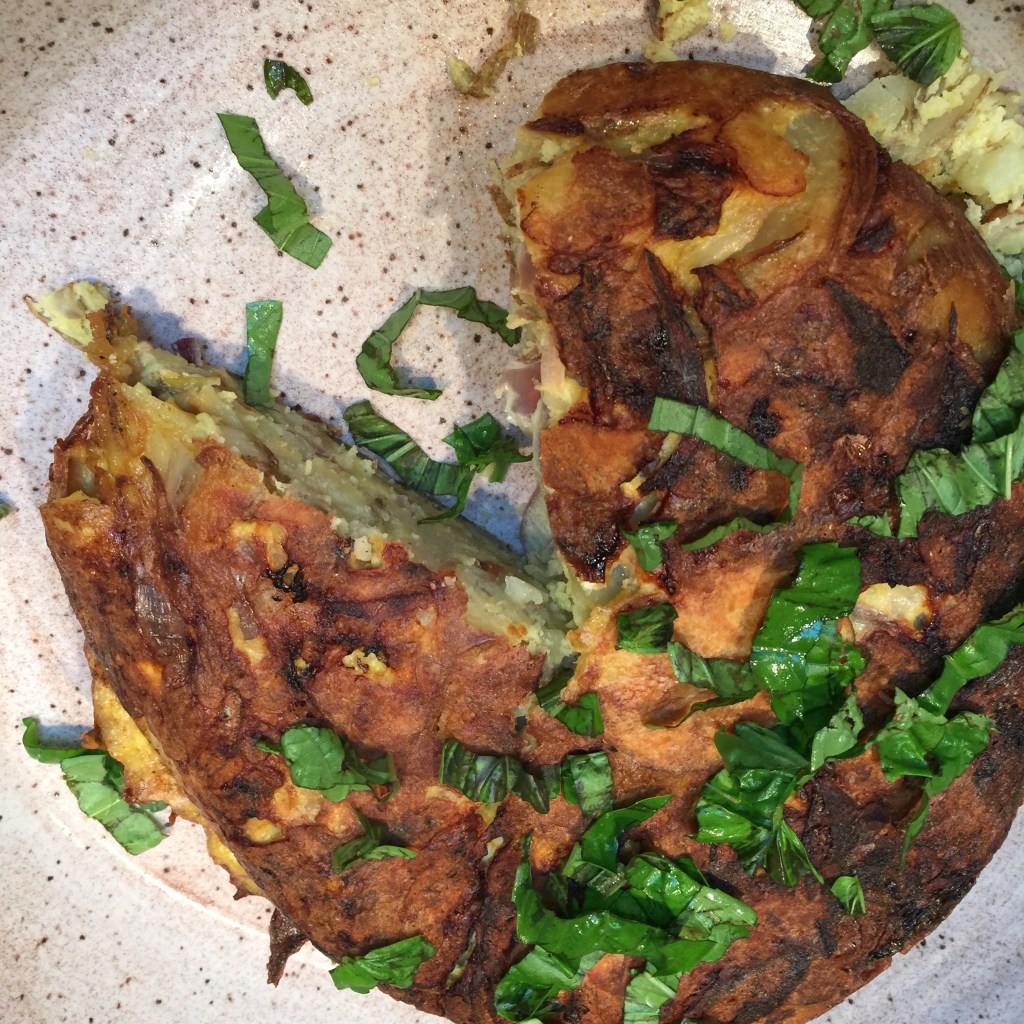
potato galette

IMG_3821

He became man and lived in this world. He ate and drank, and this means that the world of which he partook, the very food of our world became His body, His life. But His life was totally, absolutely eucharistic—all of it was transformed into communion with God and all of it ascended into heaven. And now He shares this glorified life with us. “What I have done alone—I give it now to you: take, eat.…”

~

Alexander Schmemann

If one intends to raise chickens, it’s a great thing to love eggs!  This spring our family acquired eight hens and as of now, we harvest six eggs a day, on average.  That’s 42 eggs a week.  So we are now gladly sourcing recipes with eggs!

This potato gallette is a really easy weeknight meal.  It’s savory with a hint of herbs from the garden.  Our egg yolks are so absolutely vibrantly orange (like the old fashioned red orange crayola color) it’s abundantly clear they are packed with choline, folate, vitamin A, vitamin E, tons of beta-carotene and plenty of omega-3 fats from the flax we feed them and the free range forage they enjoy.  If your interested in how the life and diet of a hen reflect in the nutrient content of her eggs, check out these results from Mother Earth News.
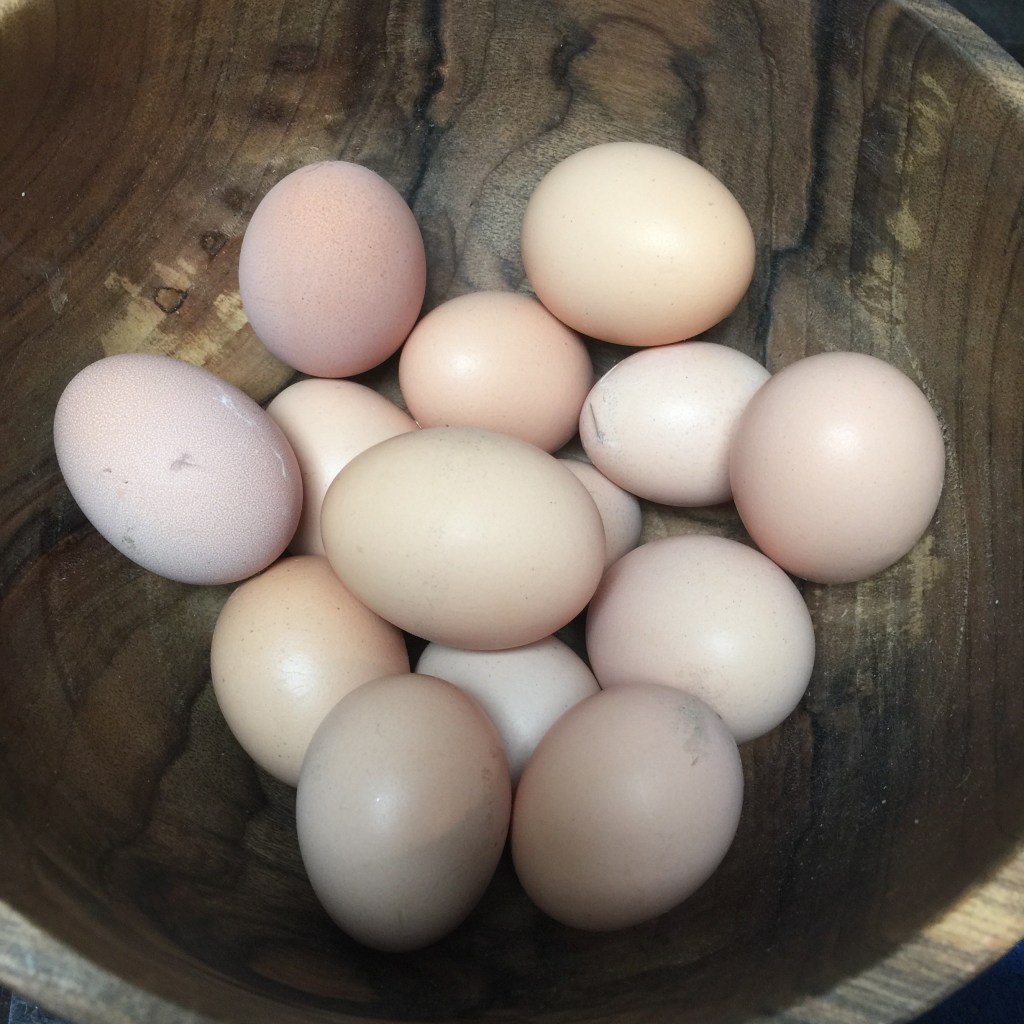
IMG_3811

Now onto the potato galette!  I strongly recommend using a well seasoned cast iron pan if you have one.  I find them non-stick far better than others, and the heat is so nice and even that it really crisps up the galette.


Before we begin, a note on the potatoes.  If you are using fresh potatoes, that have not hint of green on them (like right under the peel) then do not peel the potatoes… lots of good nutrition there.  If however, your potatoes where not stored well and they have that green you can either peel the parts with the green or peel the entire potato.  My grandmother, who grew up in Germany during a time of root cellars, world wars and no refrigeration always told me that the green on the potatoes is poisonous.   You can read more about it here in this short article in the New York times.  Storing potatoes properly is very important.  They will begin to sprout depending on light and temperature.  GrowAGoodLife has a great article on potato storage.

Ingredients:

  • Olive oil – enough to coat the potatoes and cover the bottom of the cast iron pan
  • 1-2 pounds potatoes, new or yukon gold
  • 2 teaspoons celtic sea salt or other natural salt
  • 1-1/2 cups onions : I prefer vidalia or some other sweet onion, but your basic yellow onion is just absolutely fine
  • 1 tablespoon fresh oregano, thyme or basil or some combination of fresh herbs
  • 5 medium cloves of garlic, peeled and minced
  • 6 large pastured eggs or 8 small pastured eggs (we have all sizes here!)
  • fresh ground black pepper

Preparation

Using a mandolin, slice potatoes about 1/8 of an inch.  Place in a very large bowl, sprinkle with salt, pepper and about three tablespoons of olive oil.  This coats them so they will not stick on pan.

Drizzle olive oil to cover the bottom of  a large cast iron skillet over medium heat.  Place potatoes in pan and cook them in batches.  You should not hear a searing sizzle, we are just par-cooking them.  They should not be turning color, and should not be soft so that they break when you remove them.  After each batch place potatoes in another large bowl.

While these are cooking, you want to crack your eggs and beat them in a small bowl.  Add herbs and a little more salt.

Once all potatoes are done, add the onions and garlic to the pan.  Saute till softened and fragrant, but not browned.  Rinse the skillet.  Add egg mixture to potatoes and toss well to coat.

Coat bottom of skillet with oil again and place over medium high heat.  Add in potato mixture.  Do NOT stir or move the mixture.

Let it cook for about ten to fifteen minutes.  The sides will start to pull away from the pan.  Again we are not going for a high heat because we want them to cook evenly and thoroughly – as well as get a nice brown on the potatoes.
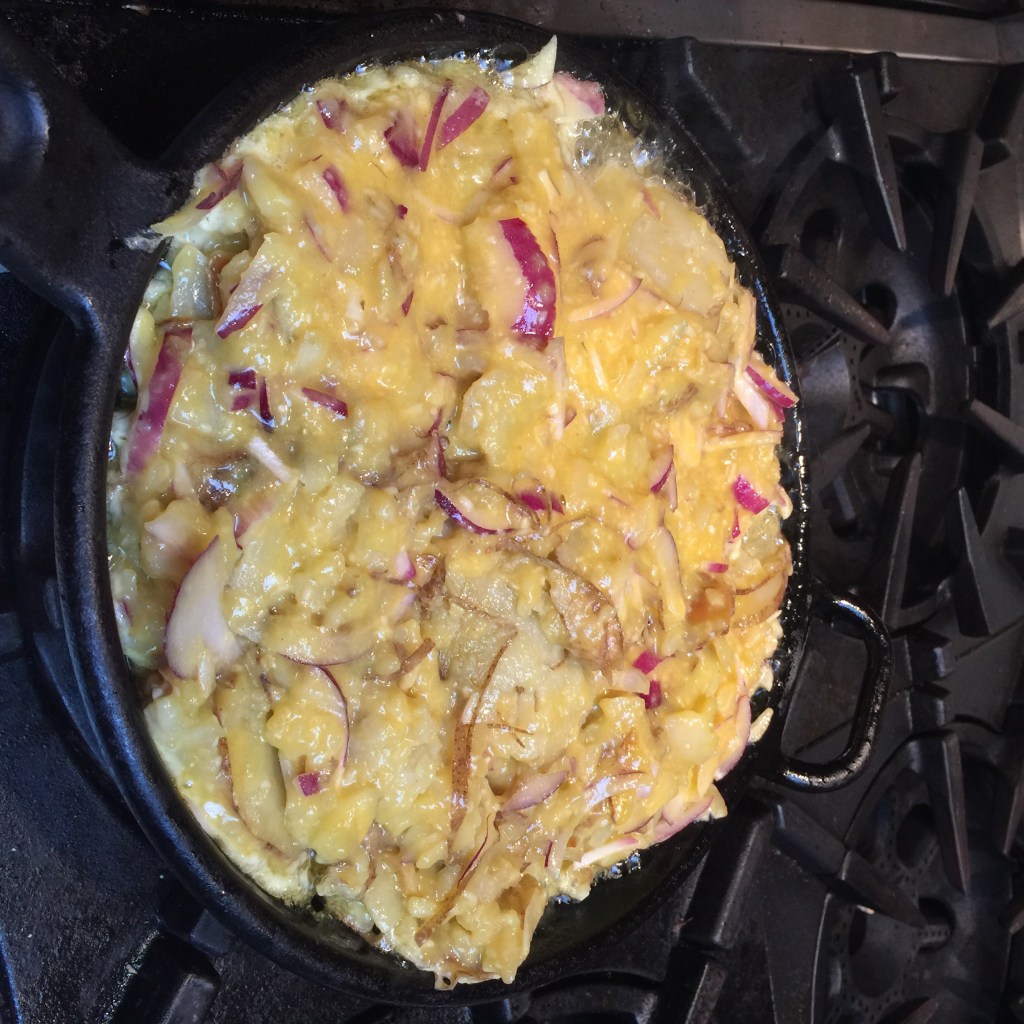
Okay, now for the fancy flip.

After about ten minutes you can start to tease the side of the galette away from the pan, if it is not starting to do so.    At this point you will want to get a plate so you can flip the galette.  The plate needs to be bigger than your pan.

Take the skillet off of the burner. Carefully, place the plate a top of the skillet.  With your hand on top of the plate turn the skillet upside down so that the potato galette falls out of the skillet and onto the plate.  Now you can slide the galette back into the skillet to brown on the other side.
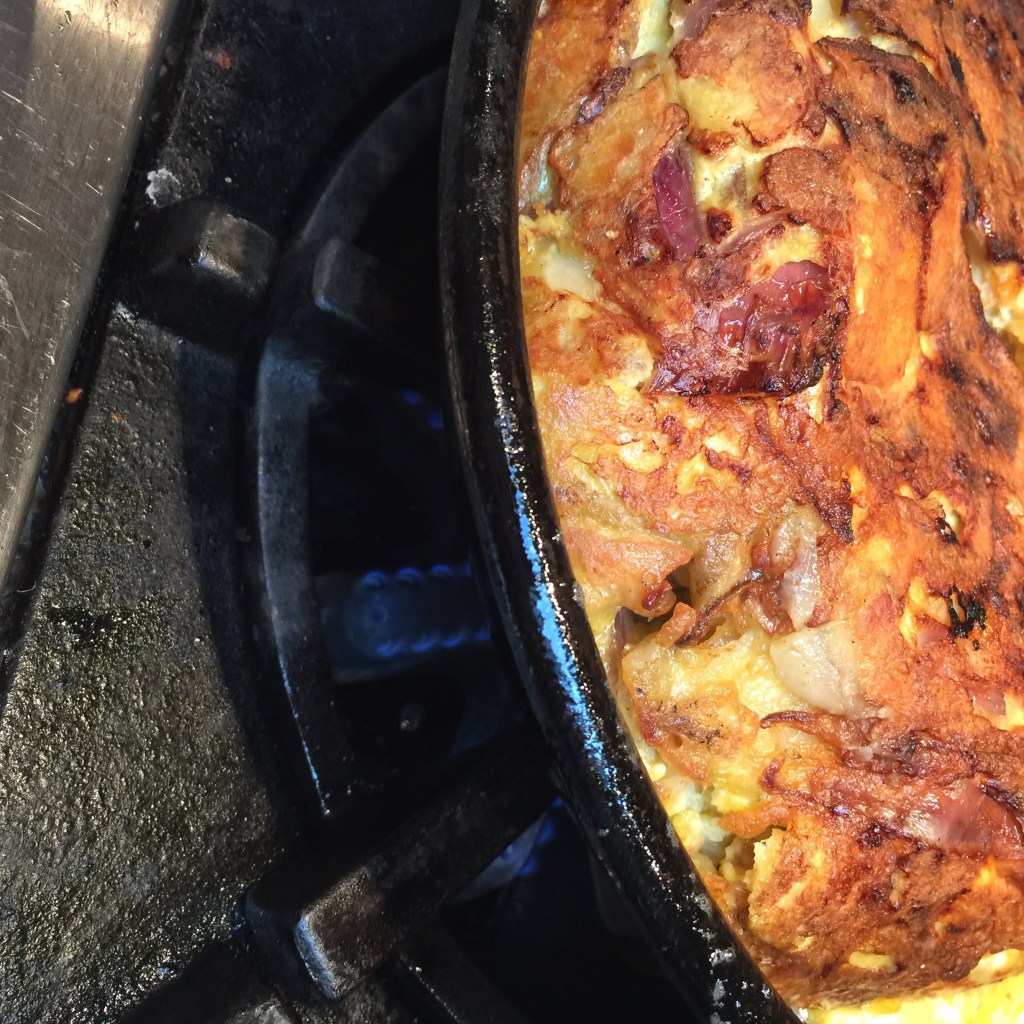
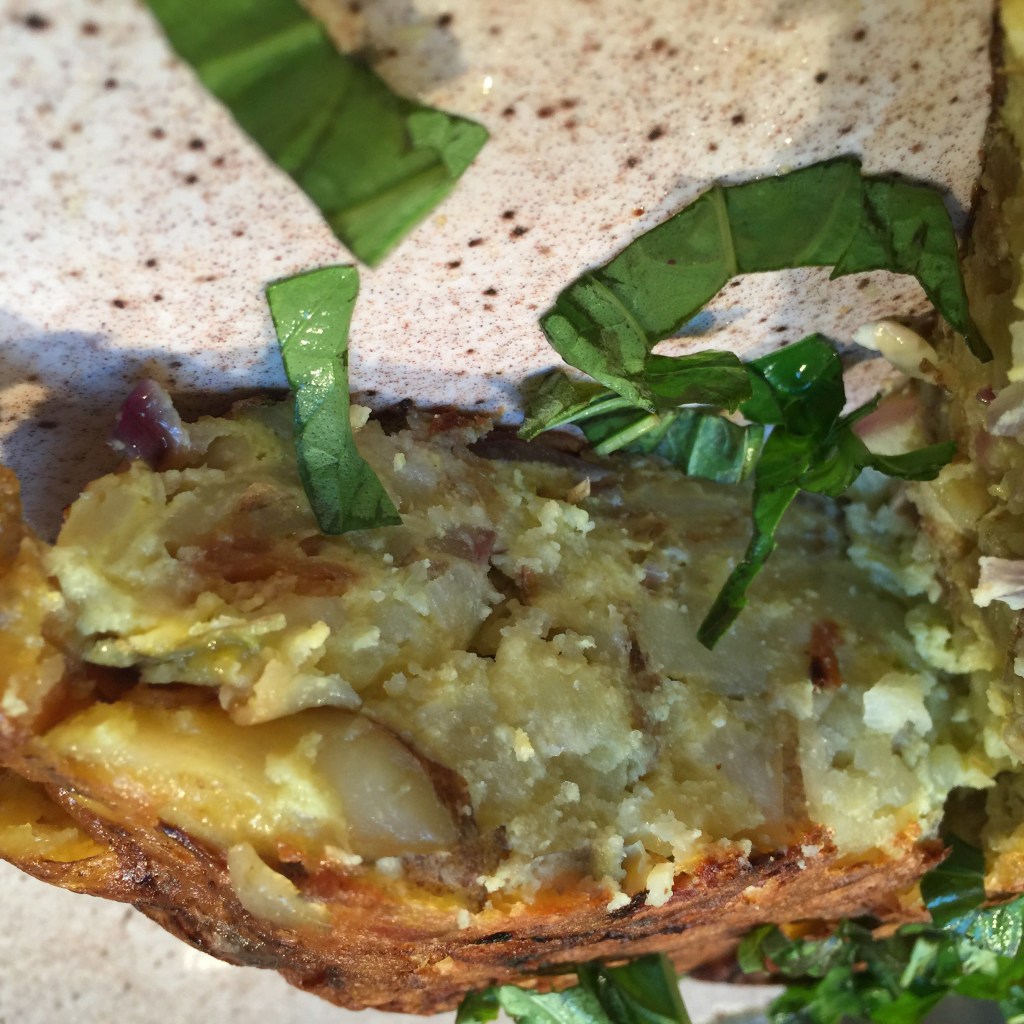
Let this cook another five to ten minutes until browned.   Remove from skillet and place on serving dish.  Garnish with more fresh herbs if desired.

Serve and enjoy.  This makes a great leftover meal as the flavors continue to melt together as time goes on!
IMG_3820


let us lift up our hearts

Reflections on the Lord's Prayer

“In order to hear the Lord’s Prayer and participate in it, it is first necessary to rid ourselves of that inner confusion, that fragmentation our attention, that spiritual sloppiness by which we constantly live… we regularly hide from everything that seems too exalted and spiritually meaningful… Indeed so much of our inner strength is directed at stifling this inner voice, which calls us to an encounter with the ultimate.” Father Alexander Schmemmann

+       +       +       +       +       +       +       +       +       +

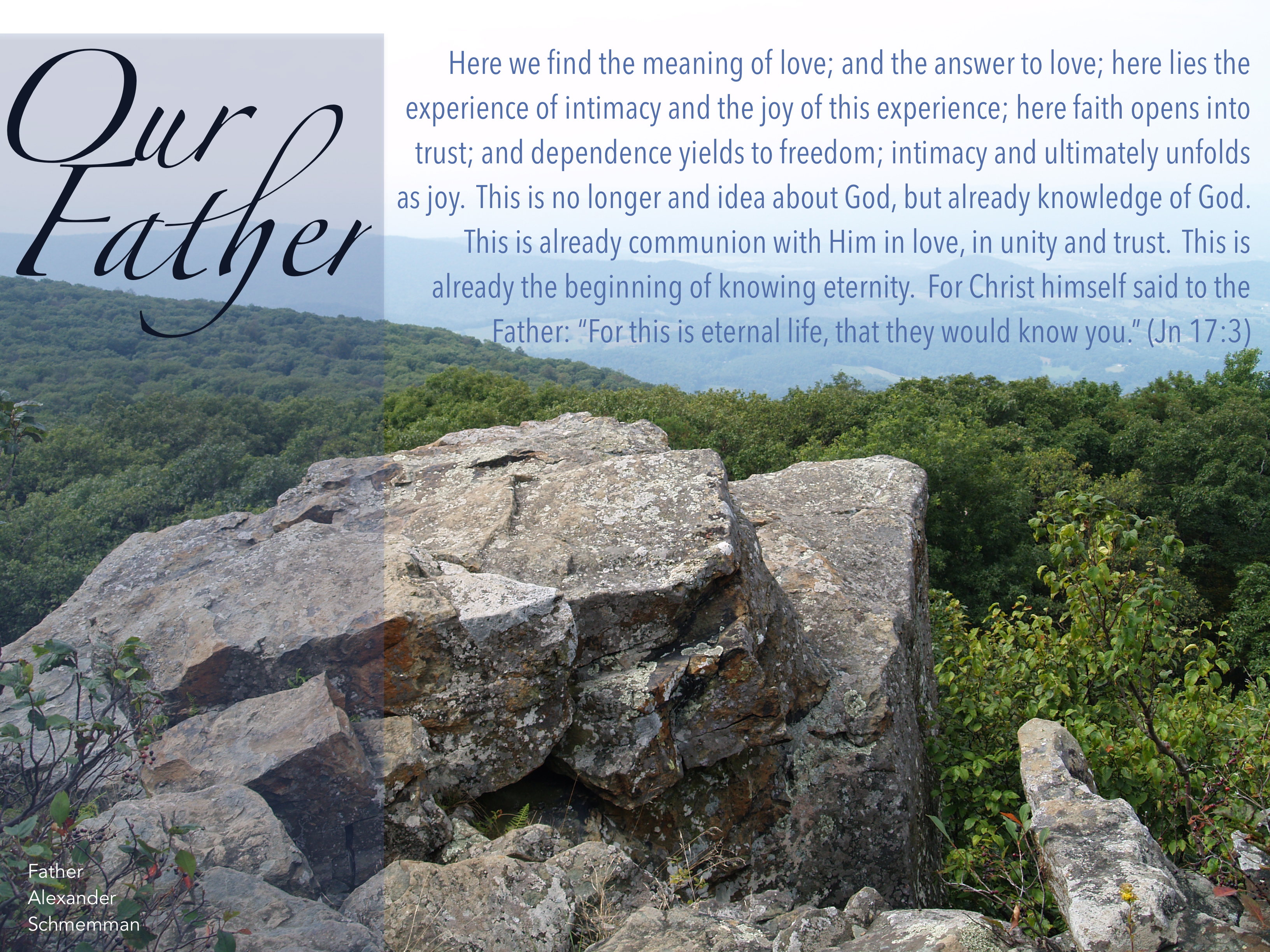
 When we say “Our Father”  … we find the meaning of love; and the answer to love; here lies the experience of intimacy and the joy of this experience; here faith opens into trust; and dependence yields to freedom; intimacy and ultimately unfolds as joy.  This is no longer and idea about God, but already knowledge of God. This is already communion with Him in love, in unity and trust.  This is already the beginning of knowing eternity.  For Christ himself said to the Father: “For this is eternal life, that they would know you.” (Jn 17:3)

Our Father : Father Alexander Schmemmann


a thousand points of light

a thousand points of lightjpg

“This prayer has been said, and without interruption for two thousand years.   At every moment somewhere on the globe, people are saying those very words which were once uttered by Christ himself.    This is why we have no better path to the heart of Christianity than by this short, and on first observation, simple, prayer. ”  

Father Alexander Schmemman

Such a parallel can be drawn with the Orthodox Liturgy,  because every Sunday, at every moment in every time zone on the globe, the Orthodox Divine Liturgy, this holy and wonderful “work of the people,”  is offered in one voice, the world round.  It is a full twenty four hour cycle of thanksgiving and praise in thousands and thousands of Orthodox Monasteries and Churches.  Each offering the “same” Liturgy in their own tongue and from their own geography.

The Divine Liturgy is Christ in our midst.  It is an encounter with the resurrected Christ.  And, in partaking of the eucharist — the “Bread of Life” — we who are many become one body…  that is the body of Christ and the living Church.

Some call the richness of Orthodox Christian worship ritual, yet intertwined in this sublime Liturgical and spiritual tradition are the threads of living, personal and authentic Christian devotion.

“Blessed is the kingdom of the Father and of the Son and of the Holy Spirit…” sets the Liturgy in motion.  This is the timeless, honest, and simple fullness of eucharistic praise – in all languages and ethnicities – offered on behalf of all and for all.


holy tuesday

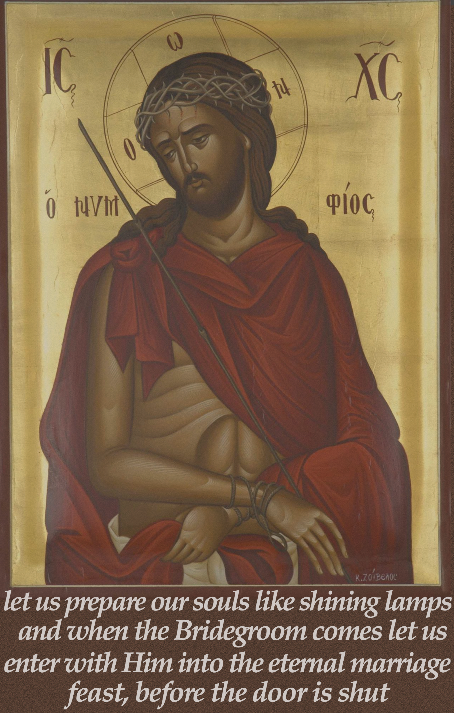
extreme humility 2015

Pascha means passover or passage

Christ is the ultimate fulfillment of Pascha.  He performed the ultimate passage : from death into life, from this “old world” into the new world and new time of the Kingdom.  And He opened the possibility of this passage to us.  Living in “this world,” we can already be “not of this world”.

Here and now, we can be free from slavery to death and sin, and partakers of the world to come.  But for this we must perform our own passage.  We must condemn the old Adam in us.  We must put on Christ in the baptismal death and have our true life hidden in God with Christ in the “world to come”.

Thus Easter is not an annual commemoration – solemn and beautiful – of a past event.  It is this Event itself, shown and given to us, as always efficient, always revealing our world, our time, our life as being at their End and announcing the Beginning of the new life.

The first three days of Holy Week challenges us with this ultimate meaning of Pascha and to prepare us to understand and accept it.

Father Alexander Schmemman


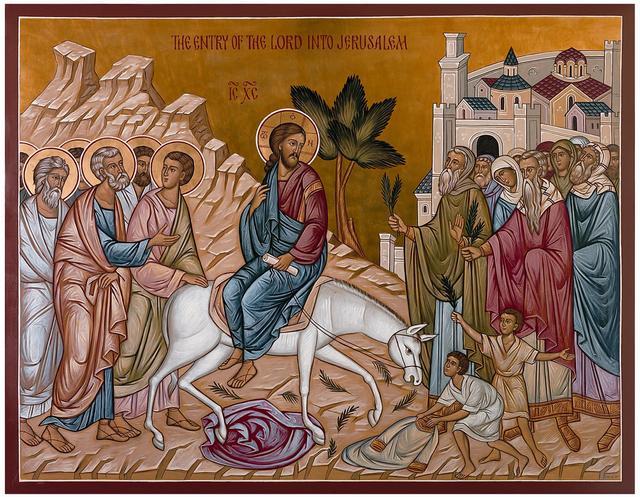
palms & hosanna

Entry_Into_Jerusalem

Palm Sunday


behold your God

ineffable . inconceivable . untameable .  humble – riding on a foal

the true Light illumining all


Today the faithful greet Him with palms and branches.

Glorious!  Triumphant!  Joy!

This is Holy Week.  Steadfast, we will journey with Christ

together with our friends and families – a community of faith.


The Last Supper. The Betrayal. Trial. Scourging. Denial.

Extreme Humiliation. Rejection. Forgiveness. Voluntary Crucifixion.


We will weep with His Most Holy Mother


chant Lamentations


And together with Joseph and Nicodemus we will beg for His body,

wrap Him in fine linen and place Him in a new tomb.

We will come hand in hand with the myrrbearers to anoint His body and find it is gone.

And on Pascha we will behold the awesome glory of His Resurrection


Great Lent is over and the faithful have emerged

– prepared for this journey through the mystery of Holy Week-

earthly cares and senseless hollow triflings aside


because even during this arduous . solemn . heart-wrenching . brutal yet hopeful path to Golgotha

His burden is easy and His yoke is light

This is Palm Sunday, and  today the faithful – filled with the hope of the Resurrection –

join with the angels & children, singing a song of victory


glory to God

Hosanna in the highest

blessed is He that comes in the name of the Lord!


“Palm Sunday is ‘the end of an entire process of preparation, as revealed in the Bible.  It was the end of all that God did for us, and thus this short hour of Christ’s earthly triumph acquires an eternal meaning.

It introduces the reality of the Kingdom into our time, into all hours, and makes this Kingdom the meaning of time and it’s ultimate goal.  The Kingdom was revealed in this world and from that hour.  It’s presence judges and transforms history…

On Palm Sunday, this reality is our own involvement in and our responsibility to the Kingdom of God… And He does not need any “symbols” for He did not die on the Cross that we may eternally “symbolize” His life…If we are not ready to stand by the solemn oath which we renew every year on Palm Sunday, if we do not mean to make the Kingdom of God the measure of our whole life – then meaningless is our commemoration and vain are the branches we take home from Church.’ “

Father Alexander Schmemman